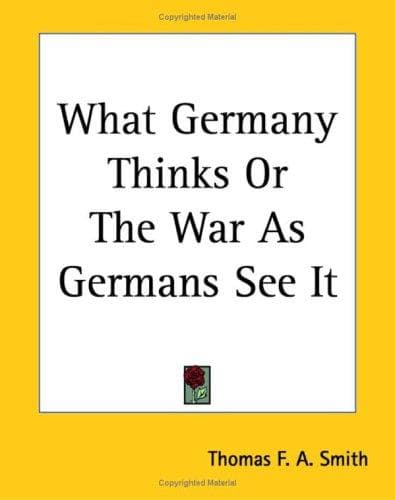
What Germany Thinks; Or, The War as Germans see itSmith, Thomas F. A.
History
What Germany Thinks; Or, The War as Germans see it
Smith, Thomas F. A.
World War, 1914-1918
"Dresden.--I was sitting in the garden of a suburban restaurant; above
me were the dark masses of chestnut trees, while before us, above the
railway, was a long strip of bright, summer-night sky. There seemed to
be something gloomy and uncanny in the air; the lamps blinked
maliciously; a spirit of still expectation rested on the people; furtive
glances were cast from time to time at the near embankment. Military
trains were expected, and we listened nervously to the noises of the
night. The first troop-transports; where were they going--against Russia
or to the French frontier? It was whispered that the troops would only
be transported by night.
"At last a pounding thud came through the stillness of the night, and
soon two colossal engines were silhouetted against the sky, like
fire-spitting monsters. Their roar seemed more sinister than usual.
Heavy forebodings rumbled out in the rocking and rolling of the endless
coaches--the clang of a future, pregnant with death and pain. Suddenly
the tables were empty; everyone rushed towards the lighted compartments
of the train, and a scene of indescribable jubilation followed as train
after train of armed men rushed by into the night.
"Sometimes a troubled father was heard to exclaim: 'If only the first
battles were fought and won!' Yet calm confidence prevailed from the
very beginning. But the sight of the quiet, machine-like completion of
the mobilization strengthened our trust, even though a justifiable
indignation and rage filled our hearts at Europe's dastardly attack on
the Central States. Hate flamed highest, however, when England declared
war against us.
"There are several reasons for this. In the north of Germany, the
Englishman is looked upon as the European who stands nearest the German,
and with whom we have the most sympathy. His personal reliability and
the manly firmness of his bearing, the culture of English social life,
English art and style, have given Imperial Germany many points of
contact and grounds for sympathy. Our historical interests have never
collided. Then we suddenly became aware that this country, under the
mask of friendship, had egged on the whole of Europe to attack us. Not
because we had injured English feelings or interests, but solely to
destroy a competitor and divide his coat of many colours.
"No political necessity compelled modern Carthage to declare war on us,
but merely the avowed aim to do a good piece of business by the war.
Without England's intrigues Europe would never have dared to attack us.
In our case, therefore, hate has sprung out of disappointed love.
England has become our mortal enemy, just as Russia is Austria's. In a
word, the two Central Powers are inspired by moral superiority over
their enemies, and are determined to wage war on them to the last drop
of blood, and if fate permits it, to settle them off and settle up with
them once for all.
Public-domain text, read in full here on John Shaqi.
Reviews
Reviews
No reviews yet
Be the first to share your thoughts on this work.
Join the Discussion
Join the discussion
Sign in to leave a comment or review.
Sign InorCreate an account