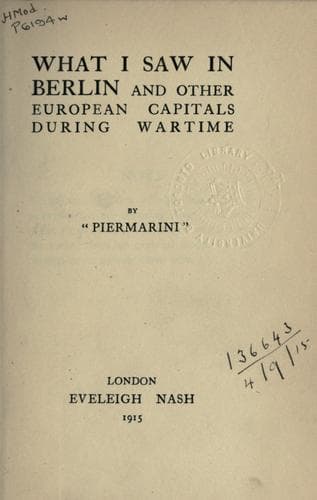
What I Saw in Berlin and Other European Capitals During WartimePiermarini
History
What I Saw in Berlin and Other European Capitals During Wartime
Piermarini
Europe -- Description and travel; World War, 1914-1918 -- Personal narratives
They gave me back my luggage, papers, and money, but in German notes
instead of gold; and though I protested, as gold fetches in Belgium
about twenty-seven francs per pound, they simply answered that no gold
was allowed in Belgium, and I had to give in on this point. But I got
any amount of pleasure, quite worth the money they made me lose, by
telling them a few simple truths, which generally one cannot afford to
tell to a German unless one happens to meet him somewhere out of reach
of the police.
* * *
After my visit to the ruined towns of East Belgium I naturally expected
to see in Brussels the depressed appearance and the lifeless look of
the other parts of the country. I was therefore extremely surprised to
find the town with all its shops and its theatres open, and with its
everyday life in full swing.
The German authorities try to keep things as lively as possible in
Brussels, and, up to a certain point, they succeed in doing so.
Officers and men have received very special orders; they can do
anything they like in the small provincial towns, but they must be
fairly polite to the population in Brussels. As long as the capital has
not been pillaged, burned, or shelled, the German Government thinks to
have in its hands proof that no useless damage was done, and that the
tragic happenings in the other towns were indirectly the fault of the
"treacherous Belgians."
Another reason for this special treatment of Brussels is that though
the Ambassadors of foreign States have left for Le Havre, a few members
of the legations of neutral countries still remain in the town who
would be compromising and official witnesses of any useless acts of
cruelty. And this is why Brussels is the only Belgian town with a
garrison of crack troops and well-to-do officers, the only town in
which theatres are open (by special command of the Government of
Brussels), and the only town in which restaurants and cafés keep open
till eleven o'clock--some even till midnight, German time.
The question of time is really very curious. One of the first acts of
the invaders was to impose, or rather try to do so, the Berlin hour
on Belgium. Everybody stuck to the old Belgian time, which is an hour
earlier than the German.
Then the Germans forced the sacristans of the different churches to put
the steeple clocks back an hour, but, as by a miracle, the old clocks,
many of which had been going for centuries, developed trouble of some
kind or another, and suddenly stopped. Now it is only the Royal Palace
and station clocks that mark German time; all the others have stopped
or are undergoing endless repairs.
The time at which his watch is set is now a sign by which you can
detect the sympathies of a person. When you sit in a tramcar or in a
café, and somebody wishes to ask you a question, he glances first at
your wrist, and, from the time of your watch, knows whether you are a
friend or a foe.
Public-domain text, read in full here on John Shaqi.
Reviews
Reviews
No reviews yet
Be the first to share your thoughts on this work.
Elsewhere in the archive
Join the Discussion
Join the discussion
Sign in to leave a comment or review.
Sign InorCreate an account