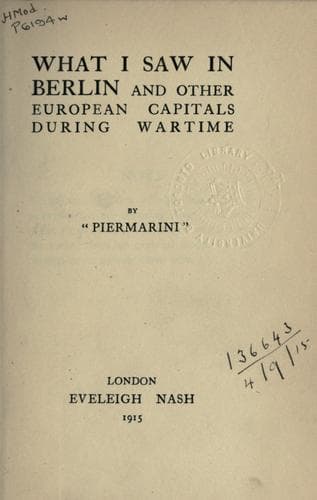
What I Saw in Berlin and Other European Capitals During WartimePiermarini
History
What I Saw in Berlin and Other European Capitals During Wartime
Piermarini
Europe -- Description and travel; World War, 1914-1918 -- Personal narratives
The great majority of the Belgian population--I mean, of the Belgians
who stuck to their homes, as should have been done by everybody--behave
in a very dignified manner, and ignore the Germans almost completely.
Nearly everybody, rich and poor, wears a Belgian rosette or King
Albert's portrait in the buttonhole, and by so doing defy the Germans,
who regularly rage at the sight.
A little story on this subject is often repeated in Brussels. A German
officer asked a lady to take off the rosette she was wearing, but she
refused.
"Very well, then," he said, "I will do it myself," and catching hold of
the rosette he threw it on the floor and stamped his foot upon it. The
lady stared at him contemptuously, and said, "After all, a rosette is
much easier to take than Paris." She then walked away.
German soldiers have lately received the order not to bother about
such trifles in Brussels, and everybody who wishes to do so can wear
the colours of his country without serious consequences. I was really
astonished at the appearance of some of the Brussels shops. Belgian
flags and large pictures of the King and the Royal family, flanked by
engravings of the Sovereigns of England and Russia, were shown in the
windows, together with some clever caricatures and artistic etchings of
"Bruxelles pendant l'occupation," a legend which means that it is hoped
the occupation will cease as soon as possible.
To say at this moment that Belgium has been stricken by famine would
be an exaggeration. Food is certainly scarcer than before the war, but
the population is less, and consequently the prices have not risen
extraordinarily.
At the restaurants the only dishes that are dearer are those that
contain eggs; for the others, the higher cost to the caterers is made
up for by smaller portions.
Bread is really the only thing that is dear. The quality, of course,
varies, but the white, pure, wholesome bread formerly to be found
everywhere as part of the excellent Belgium cooking, is no more.
From the Antwerp bread, which has now a funny taste as of dust, and the
soft part of which is browny, full of dark spots, wet and granulous,
to the brown soldier-like _pain d'ammunition_ one gets in Tournai,
from the maize and millet bread of Malines, to the still white but
damp and curiously tasteless bread of Brussels--all the bread which
was served to me during my Belgian trip showed clearly all the tricks
used to provide the country with its indispensable daily bread. What in
ordinary times would have been judged only fit for animals is now sold
at very high prices and makes the base of the flour employed.
In places like Brussels, where a certain quantity of good flour is
still obtainable at very high prices, the bread is made with a mixture
of wheat, potato, and maize flour, but in most towns the wheat has been
used up, and the bread has to be made without it.
In all the western parts of Belgium, all that remains of the old supply
of corn is used for the wounded and the sick.
Public-domain text, read in full here on John Shaqi.
Reviews
Reviews
No reviews yet
Be the first to share your thoughts on this work.
Elsewhere in the archive
Join the Discussion
Join the discussion
Sign in to leave a comment or review.
Sign InorCreate an account