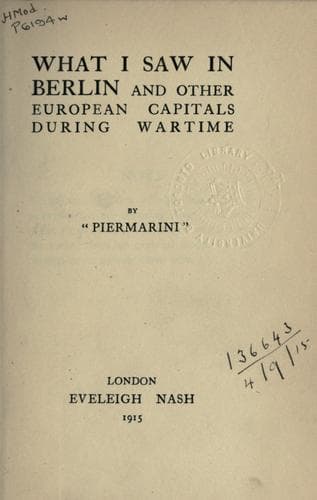
What I Saw in Berlin and Other European Capitals During WartimePiermarini
History
What I Saw in Berlin and Other European Capitals During Wartime
Piermarini
Europe -- Description and travel; World War, 1914-1918 -- Personal narratives
The German waiters of the Palace, the Metropole, the Cecil, and all
other big hotels in Brussels appear to have been working their very
best for the Fatherland before the war began. Now they have left their
humble jobs, thrown away their mask, and found new employment with the
central police. In Brussels there are any number of such people, who
now carry themselves proudly with a white, black, and red armlet and a
pistol-case bulging beneath their coats on the left hip.
Very few motor-cars are seen in the streets, and during my stay of
more than a week I did not see a single car driven by a civilian. The
petrol question seems to have become extremely serious. All the motor
garages are closed, and it is impossible to obtain the spirit at any
price, not only in large quantities, but even in small bottles from a
chemist's shop.
This accounts for the boom in acetylene lamps and carbide. New large
shops selling these goods have opened all over the country. In most
villages gas and electric light have been cut off, and this is the only
means of obtaining any light.
Here, again, Brussels has very special treatment. The town at night is
as full of light as usual--probably because the Germans know perfectly
well that if the Allies should attempt an air attack they would almost
certainly damage the civilian population more than the occupiers. Very
often, in the daytime, a Zeppelin will appear over the town; people are
so used to the sight that they take little or no notice.
To sum up: the Brussels population has become accustomed very quickly
to the new situation. Nobody seems to mind the incessant rumble of the
guns in the distance, nor the food scarcity and high prices, nor the
abnormal life of the town. Nor the lack of amusements.
I have said some theatres are open; they are, but only for the Germans.
The Belgian people refuse to go to them for two good reasons. They
do not want to mix with the Germans, and they do not think it right
to enjoy themselves when their country is reduced to such pitiful
conditions and their King and the remnants of his army are fighting on
the last bit of Belgian soil.
For the Germans there are even music-hall shows and dances, and, with
that beautiful sense of tradition which, according to Nietzsche, is one
of the secrets of German clumsiness, even the decrepit institution of
Tango Teas is still kept alive. And there the Hun stuffs himself with
more champagne and costly food.
At ten miles' distance from Brussels the inhabitants of Forest have
been rationed at half a pound of brown bread per head.
* * *
Public-domain text, read in full here on John Shaqi.
Reviews
Reviews
No reviews yet
Be the first to share your thoughts on this work.
Elsewhere in the archive
Join the Discussion
Join the discussion
Sign in to leave a comment or review.
Sign InorCreate an account