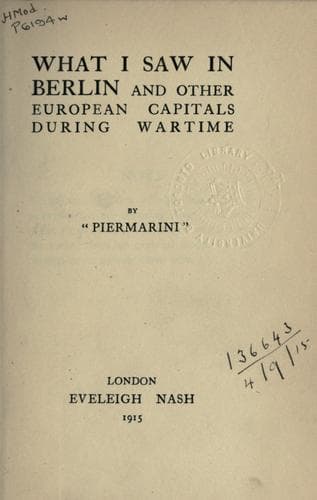
What I Saw in Berlin and Other European Capitals During WartimePiermarini
History
What I Saw in Berlin and Other European Capitals During Wartime
Piermarini
Europe -- Description and travel; World War, 1914-1918 -- Personal narratives
"This war," continued the lady, who bears one of the oldest and best
names of Belgium, "this war has produced in our country a new form of
socialism--a socialism which has nothing in common with the theories
of Bebel or Marx, but which seems to derive its origin from the
Commandments of the Bible.
"I know of ladies who would not, before the war, have thought it in
themselves to do any such useful work as looking after entire families
of refugees; others have been converted by the circumstances of war
into efficient sick nurses, relief organisers, and even into cooks for
our kitchens for the poor. I know of families who would have shivered
at the idea of having a stranger in their home, especially if that
stranger happened to be of low class, who are now giving hospitality
to whole families; I know of middle-aged gentlemen who almost every
week risk their lives to go into Holland to get letters from soldiers
fighting at the front and to bring back hope to hundreds of families.
These and our soldiers are the true Belgians."
Poor people often told me the same thing. "Do you think we are of the
kind to allow the Germans to turn us out of our own houses?" a little
Belgian woman asked me. She was living with her five children in a
little ruined cottage near Liége, while her husband was fighting at
the front. A piece of shell remained jutting from a wall of the little
house, which had newspapers at the windows instead of glass.
"I did not bother to have new glass put in just yet," said the little
woman, smiling; "first of all because we have no money to spare, and
also because we expect to see more fighting soon; at least, we hope
so. We know it will be hell when the Germans are pushed back, but we
are waiting anxiously for that moment. Ah! sir, this is not life; this
is worse than all being dead," she ended, kissing the fair head of her
last-born--born since the Germans came.
In many, many towns did I hear this very same hope expressed by all
kinds and conditions of people and in the same manner: "When are we
going to get rid of them?"
"_Get rid of them_" does not mean only that the Belgians desire to
reassume the dignity of a free nation, have their own rulers, nor see
any more pointed helmets, but also that they want to be able to start
business again, to live, to eat, to be free in every sense of the word.
The subject of a country which has not suffered invasion for centuries
and centuries can hardly realise what all this means.
* * *
Perhaps the most intolerable portion of the occupants are the
civilians, who have come down in big numbers, following in a week or
two the German Army. They have joined the other Germans, those who have
been preparing for years the ground for the future invasion. Some are
occupied at the Kommandantur, some are organising the railway service,
but most belong to the secret service and to the police offices.
Public-domain text, read in full here on John Shaqi.
Reviews
Reviews
No reviews yet
Be the first to share your thoughts on this work.
Elsewhere in the archive
Join the Discussion
Join the discussion
Sign in to leave a comment or review.
Sign InorCreate an account