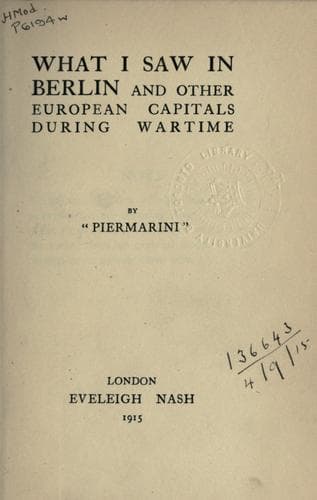
What I Saw in Berlin and Other European Capitals During WartimePiermarini
History
What I Saw in Berlin and Other European Capitals During Wartime
Piermarini
Europe -- Description and travel; World War, 1914-1918 -- Personal narratives
Near one of the side colonnades a gentleman standing on a chair shouts
the latest war news through a megaphone to a crowd of listeners.
Everybody is anxious for news of Antwerp, because I understood it was
clearly realised when that city capitulated or was taken by the Germans
the besieging army would be released. Then on to Paris!
At the Pariser Platz I see wounded officers being taken into the large
private houses which are used as Red Cross hospitals, and a large crowd
receives them with sympathetic cheers.
One of the most remarkable things in Berlin is the number of private
houses, hotels, and museums turned into hospitals; and the conclusion
I came to is that the British estimates of the number of German
casualties are not at all exaggerated. Berlin is a city of wounded
and distressed, gay as it is on the surface; only the authorities are
careful to keep this fact as dark as possible. No official list of dead
and wounded is issued, and the families are generally told by means of
printed letters that Hans or Fritz will not come back.
Some papers started at the beginning of the war to give lists of dead
officers and men, which they drew up by means of private inquiry. Now
this has been stopped, and only now and again do the papers talk of the
glorious death of Captain or Lieutenant So-and-so.
The censorship in Berlin is much more strict than in London. Some
newspapers have disappeared; some have reduced their dimensions;
others, that tried to be coherent with their past political ideas,
have been boycotted even by the section of the public which used
formerly to support them.
For instance, to read _Vorwaerts_ in public in Berlin is an action
which requires a certain amount of heroism. The newspaper which in the
last two months has been suppressed three times by the Censor, and
three times allowed to appear again on the promise of good behaviour,
is almost the only one which shows any independence of the military
Press office, and dares to tell news other than optimistic to the
Berlin public.
Wishing to read something fairly truthful about the war, I was scanning
this newspaper while riding in a tramcar on my way to the War Fund
garden party, which was, at the moment, the great attraction of all
Berlin.
An elderly gentleman, sitting opposite me, after looking suspiciously
for a long while at the paper and at myself, addressed me with this
extraordinary remark: "To be a Socialist at the present moment is to be
an enemy of the Fatherland. You should be ashamed to read a paper like
that when you should be fighting for the country."
I answered that I read what I liked best and that he need not worry--I
would gladly fight for my country as soon as she was at war. When
the old man heard I was an Italian he commenced, tactless as only a
German can be when he is of the tactless sort, a long talk about the
treacherous politics of Italy, the punishment Germany is going to give
her, and other similar nonsense.
Public-domain text, read in full here on John Shaqi.
Reviews
Reviews
No reviews yet
Be the first to share your thoughts on this work.
Join the Discussion
Join the discussion
Sign in to leave a comment or review.
Sign InorCreate an account