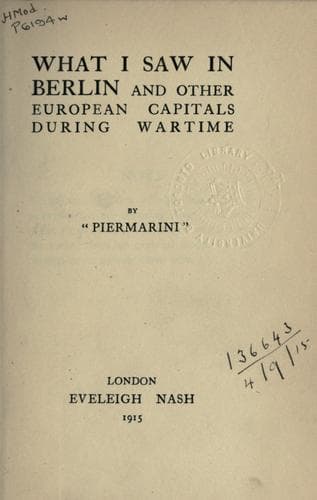
What I Saw in Berlin and Other European Capitals During WartimePiermarini
History
What I Saw in Berlin and Other European Capitals During Wartime
Piermarini
Europe -- Description and travel; World War, 1914-1918 -- Personal narratives
"So have I, but who can tell that the bullets have only been made
'dum-dum' after the cartridges have been served out? A soldier may
individually, without any officer telling him to do so, cut with
his pocket-knife across the part of the bullet which protrudes from
the brass part of the cartridge. The result is not that of a real
'dum-dum,' of course, but it is quite a good imitation. In a case like
this the Government to which the individual soldier belongs cannot be
called responsible for the violation of the Hague Convention."
We walked out, as he had to get back to the barracks. I had no
programme for the rest of the afternoon. I walked straight on and found
myself in the Linden.
I noticed that the few shops of English firms in Berlin were closed, as
were also the agencies of British ship companies.
The first night of a great military drama was announced for the
evening, and curious little carriages covered by a sort of large square
box with the sandwich man completely concealed inside, showed large
posters with scenes of the drama. One exhibited a wonderful allegoric
picture with a bulldog, a bear, and a cock transfixed by the large
sword with which they had been killed. Needless to say, on the top of
it was a large Prussian eagle.
The crowd of shoppers and idlers was going mostly towards the
Schloss-Brücke, and having nothing better to do I followed the current
of the people.
In the Lustgarten a large crowd was waiting with an expectant air,
gazing at the central balcony overhanging the main entrance of the
Schloss. Before I had time to ask the reason of the excitement, one of
the French windows was opened by valets, and a tall lady, accompanied
by three children, dressed in white, came out and bowed smilingly to
the crowd.
An enormous cheer received the Kronprinzessin. After remaining on the
balcony for a few minutes, during which she repeatedly bowed and kissed
the fair head of her eldest son, she retired, loud cheers being again
raised.
I asked the reason of the demonstration, shivering at the idea that a
big success had been obtained by the German and that this was the way
the Berlin population expressed loyalty to its rulers.
"Why, she appears every afternoon!" I was told. "A crowd comes here
every day at four o'clock. It has been so since the beginning of the
war."
"Even when the war news was not very good?" I asked.
"The news has always been very good," said my informant in a
contemptuous tone, and away he walked, disgusted at my disrespectful
remark.
The crowd had now melted away slowly, and the Lustgarten had resumed
its air of aristocratic calm. In front of me was the huge mass of the
Imperial Palace, with the large bronze groups given to the Hohenzollern
family fifty years ago by the grandfather of the present Tsar.
Public-domain text, read in full here on John Shaqi.
Reviews
Reviews
No reviews yet
Be the first to share your thoughts on this work.
Join the Discussion
Join the discussion
Sign in to leave a comment or review.
Sign InorCreate an account