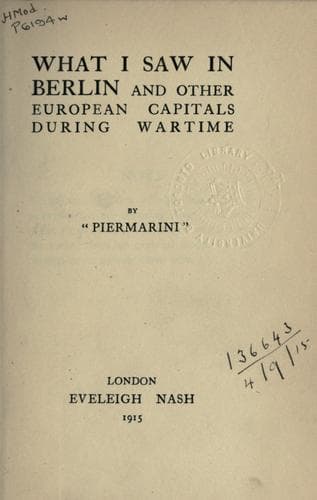
What I Saw in Berlin and Other European Capitals During Wartime — John Shaqi
What I Saw in Berlin and Other European Capitals During WartimePiermarini
History
What I Saw in Berlin and Other European Capitals During Wartime
Piermarini
Europe -- Description and travel; World War, 1914-1918 -- Personal narratives
But though war is undoubtedly decided on the battlefield, it is no less
certainly reflected in the life of the capitals of the belligerent
nations. As long as hope, money, food, fresh supplies of men and
ammunition are forthcoming, a nation retains a normal appearance; but a
reverse on the battlefield is almost immediately transmitted throughout
the country. Especially in the large towns, where bad news always
manages to come through quickly, one can detect, from a thousand and
one signs, to what degree the population has been affected.
We have only to remember how London and Paris looked in September last,
and to compare the practically "Business as usual" life of to-day, to
appreciate what a sensitive thermometer is the population of a great
city.
The task I have essayed during the last five months has been to look
at these thermometers with the eye of a doctor--sometimes anxious,
sometimes unsympathetic, but always, I trust, impartial. The great
capitals of Europe have been the aim of my journeys.
Upon my desk lies a cheap war-map cut from a daily paper. It is
scribbled all over with blue pencil marks--marks which represent my
wanderings across Europe since the beginning of the war. The atlas I
have just consulted tells me I have travelled fifteen thousand miles;
fifteen thousand miles of travel, during which time I met continuously
new people, people of different temperaments, different nationalities,
different religions; but all interested in one subject, and talking
about one subject only--the war.
I have visited eight large capitals of European States, lived their
lives, felt the intense wave of their sympathies, hates, sorrows, and
joys, strong, of course, in a terrible crisis like the present.
From London to Paris, from Berlin to Amsterdam, from Vienna to
Brussels, from Rome to Athens and Constantinople, all the European
capitals show more or less the effects of the war. Curiously enough,
Rome, Amsterdam, and Athens--capitals of States as yet neutral--are
among the cities most altered, while least changes are to be seen in
the town which has given to the war almost the whole of her adult
sons--Berlin.
When one wishes to obtain, during a short visit, as true and as many
impressions as possible of a town, the best thing to do is to sit in
a café where the literary-journalistic element resorts. In the large
room of the Café Royal in London, or under the deer-heads of the Bauer
in Berlin, on the horrid yellow velvet sofas of Aragno in Rome, or on
the verandah of the Ianni in Constantinople, the people talk freely.
In such places the opinions of the different classes are reduced to a
common denomination--public opinion; tongues wag more freely, loosened
by the favourite drink, be it whisky and soda, beer, coffee, or sherbet.
London is decidedly optimistic; there is certainly a little
apprehension on the score of Zeppelins, and the probability of a
lengthy war; but every Briton _knows_ that England will ultimately come
out on top.
Public-domain text, read in full here on John Shaqi.
Reviews
Reviews
No reviews yet
Be the first to share your thoughts on this work.
Join the Discussion
Join the discussion
Sign in to leave a comment or review.
Sign InorCreate an account