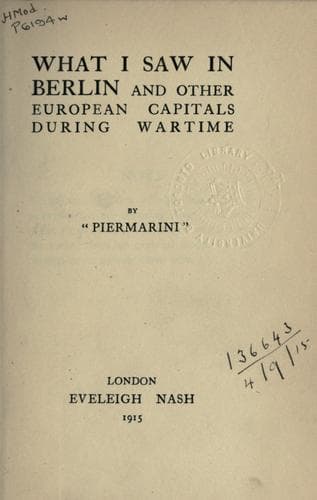
What I Saw in Berlin and Other European Capitals During WartimePiermarini
History
What I Saw in Berlin and Other European Capitals During Wartime
Piermarini
Europe -- Description and travel; World War, 1914-1918 -- Personal narratives
Only the night before the key to the enigma had been given me by a
dragoman who, though in a lower social scale, could nevertheless speak
German:--"We did not want this war," he said. "We did not want either
the Balkan War or the war against Italy, but, after all, we know
perfectly that the more silly things our rulers do, the sooner they
will have to go, and the sooner the better.
"We are tired of the so-called Young Turk Government. It is worse than
the Government of Abdul Hamid. Things being as they are, we keep quiet
and hope it will be over as soon as possible."
"But you would not like to have a Russian Government, for instance?"
said I.
"It would not be worse than this one," he answered. "None could be
worse. One fine day, when things go badly, Enver Bey and all the Young
Turks will clear off with the money they have made at our expense, and
leave us to settle the account. They don't care at all for Turkey.
They only care for their private ambitions. Most of them are not Turks
either, but Greeks or Armenians or Levantines or Jews.
"The Turkish people have realised long ago that Turkey, as a nation,
resisted as long as she did because the European nations could not
agree on her partition. The only thing to do was to keep quiet and try
to avoid any struggle. We should have done that if Abdul Hamid had not
been deprived of his power; our new rulers had the dream of making
Turkey once more a Great Power. But their efforts had quite an opposite
result."
All this may sound rather tragic, but it was spoken as if it was the
most natural thing in the world for a modern Turk to regard himself as
simply the citizen of a country that was up for sale by auction.
My informant did not even seem to care to know who the buyer might be.
The dragoman represents the most patriotic part of the population of
Turkey--the Turks. As for the other elements--Greek, Bulgar, Armenian,
Serbian, Wallach, Gipsy, and Jewish, which are in numbers ten times
superior to the Turks--they have different aspirations, and naturally
look for a change in the direction of their own nationality or, at
least, of their own religion.
The only people who have sympathy for Germany seem to be the Jews
and Gipsies, the former, who live mostly on the Bosphorus and the
Dardanelles, being closely connected with Germany by commercial
interests.
It is in this attitude of complete passivity that the population of
Constantinople is waiting. The attempt to wake up the Islamic feeling
is not likely to have a great influence in European Turkey.
To-day in most places meetings have been arranged, and muezzins have
started promising the paradise of Allah, the Houris and all the rest,
to those who are ready to die for the Motherland and the true God.
My dragoman told me they did not arouse much enthusiasm amongst the
population. I heard a Moslem preacher myself address the Mevlevis, the
dancing Dervishes, who were giving an extra performance.
Public-domain text, read in full here on John Shaqi.
Reviews
Reviews
No reviews yet
Be the first to share your thoughts on this work.
Join the Discussion
Join the discussion
Sign in to leave a comment or review.
Sign InorCreate an account