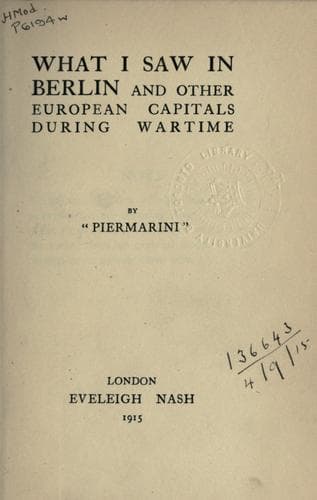
What I Saw in Berlin and Other European Capitals During WartimePiermarini
History
What I Saw in Berlin and Other European Capitals During Wartime
Piermarini
Europe -- Description and travel; World War, 1914-1918 -- Personal narratives
While I was admiring the really imposing scene, made even more
fantastic by the flashing lights of hundreds of lamps, which emulated
the light of the sun coming in copiously through the windows, wide
open, four new _imans_ took charge from the old ones. The sword will
be exposed a whole week, and during this time four of the highest
_cheiks_ of the temple will be in continuous prayers around it.
While leaving the Temple I crossed the side passage of the Gyneceus.
Here is the old door through which the priest who was celebrating the
mass when, according to Greek tradition, Mahomet the Conqueror rode on
horseback right in the middle of the church in 1454, disappeared with
the altar cup and his sacerdotal ornaments. The Turks ran after him
to kill him as they had done with thousands of people who had sought
asylum in the temple, but the door was immediately closed by a stone
wall.
When St. Sophia is given back to the Christian cult, continues the
Greek tradition, the priest will reappear and continue the service at
the very point at which he was interrupted.
It is one of the finest of popular beliefs, quite worth keeping alive
for its own sake.
I wonder if the moment when the Greeks will have to admit that their
beautiful tradition is only a legend is not coming sooner than they
thought.
* * *
_November 3rd._
I have now been two days in Constantinople; I have compared the present
condition of the Army, of the Navy, and of the different Services
with their condition four years ago, when I came first to the Turkish
capital. I have recalled to my mind what I saw at Tripoli, three years
ago, when the Turks demonstrated their worth from a military point of
view; and, finally, I have taken into consideration the lessons to be
learned from their conduct in the Balkan War.
There is only one possible conclusion: there is a big change in
everything; there is the evident mark of somebody who pulls the
strings, and pulls them with a definite object, and with strong and
delicate hands.
That somebody is Enver Pasha.
Till a few weeks ago the question: "Is Enver Pasha really a clever
politician and a first-rate military man?" would have had one answer
only--"Of course he is; he is the only great man of Turkey; as long as
he lives Turkey will have some hope of resurrection."
This man, who has the celebrity and the ambition of a little Napoleon,
is, at the bottom, nothing more than a child with a large dose of
vanity. He worships publicity, he loves to see his photographs in the
big foreign papers, to read the gossip about his private life, in which
he used to pose as a _blasé_ man of the world, surrounded by a full
score of wonderful princesses wanting only to marry him. His vanity
went as far as to make him proceed legally against a photographer who
dared to publish a picture postcard showing Enver as he really is,
short and stoutish.
Public-domain text, read in full here on John Shaqi.
Reviews
Reviews
No reviews yet
Be the first to share your thoughts on this work.
Join the Discussion
Join the discussion
Sign in to leave a comment or review.
Sign InorCreate an account