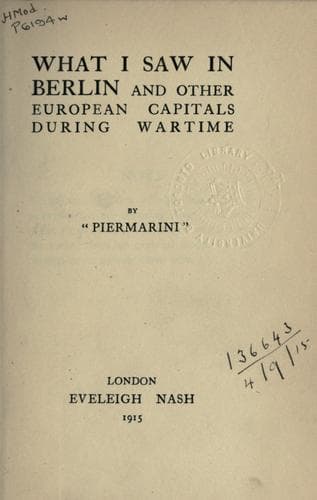
What I Saw in Berlin and Other European Capitals During Wartime — John Shaqi
What I Saw in Berlin and Other European Capitals During WartimePiermarini
History
What I Saw in Berlin and Other European Capitals During Wartime
Piermarini
Europe -- Description and travel; World War, 1914-1918 -- Personal narratives
"Is there such a war? But why? What for?"
Then it was my turn to be perplexed. The "Why?" was already a difficult
question, which would have required half an hour to be answered
properly; as for the "What for?" I had absolutely no reason to give
the old man. Who knows exactly what for? However, I tried to condense
my answer in a word. "Jealousy, you know," I said after a moment.
"Jealousy! Just like at the time of Helen of Troy!" commented my
learned partner.
"Yes, just about it."
"I didn't think people could still be such fools! When we last heard of
war here it was two years ago. Well, the Turks have gone, the Greeks
have come, and things are exactly like they were before, only we have
to pay more taxes. I suppose the same will happen over there."
"I am afraid so, too."
"And who is winning? How long is it going to last? What will be the
result?"
"I really cannot tell you all this," I had to admit.
"You don't seem to know much more about it than I do," he said in
conclusion, and, after a few seconds, in a relieved tone of voice,
which clearly meant "Let us go back to an interesting subject:--"
"Have you ever read Æschylus's _Persians_?"
* * *
I had decided to take the boat at Salonika for Athens, so I took the
train from Dedeagatch to Salonika. A three hours' stop near Porto Lagos
made me realise that it was impossible to reach Salonika in time, so I
got out of the train at Drama,[1] and from there, on a dreadful little
two-wheeler, a sort of Irish jaunting-car pulled by a horse as thin as
a horse can possibly be, I made my way to Kavala, just in time to catch
the boat which was to take me back to the civilised world.
I shall never forget my ride to Kavala. I promised a generous tip to
the _auriga_ provided he went at full speed. The little horse, under
the whip used incessantly by the young man, seemed converted into one
of the fantastic animals of the French _chansons de geste_. With neck
outstretched, the long mane loose to the wind, he took to a furious
gallop, nor did he stop until we reached our destination. The road, if
road it can be called, was full of stones and deep cart-ruts, now muddy
and now dusty, uneven, and terribly steep. We were crossing the land on
which the battle of Philippi was fought. Even now the country retained
a sort of tragic look. Not a single house, not a single tree; nothing
but stones and bare soil. The sun was hiding slowly behind the hills of
Sérès. The great battlefield appeared to me under a sky covered with
black clouds edged with scarlet on a sunset of deep orange. And yet
this battlefield, the memory of which has lasted so strongly after two
thousand years, has swallowed less life than any of the battles of the
present war!
I believe optimists call this human progress....
* * *
Public-domain text, read in full here on John Shaqi.
Reviews
Reviews
No reviews yet
Be the first to share your thoughts on this work.
Join the Discussion
Join the discussion
Sign in to leave a comment or review.
Sign InorCreate an account