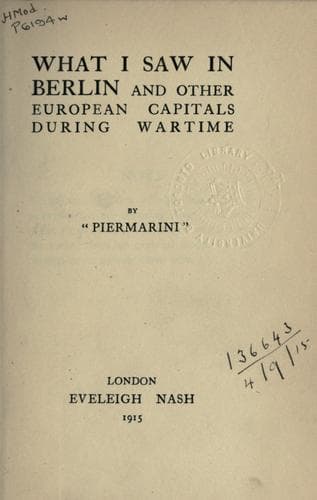
What I Saw in Berlin and Other European Capitals During WartimePiermarini
History
What I Saw in Berlin and Other European Capitals During Wartime
Piermarini
Europe -- Description and travel; World War, 1914-1918 -- Personal narratives
The victory of our arms is certain. Since Frederick the Great Germany
has attributed to God the habit of being on the strongest side; now
we can say that He is behind our guns. But even if they are not the
strongest, God is with us all the same. He gave us our genius, our
culture, our art, our music; He gave us the mission to make us teach it
to the whole world.
The victory is certain, but we must afterwards be worthy of it.
At this moment it was that I really saw a new Berlin, a Berlin
unsuspected, a Berlin I did not know, a Berlin which is really a
creation of the war.
Five thousand people had come to this theatre to hear that God is not
neutral. After the preacher had finished the people sang:--
A safe stronghold our God is still,
A trusty shield and weapon;
He'll help us clear from all the ill
That hath us now o'ertaken.
The ancient prince of Hell
Hath risen with purpose fell;
Strong mail of craft and power
He weareth in this hour;
On earth is not his fellow.
After that a sudden extraordinary and fascinating thing happened. The
preacher, with his strong, calm voice invited the audience to pray with
him; Pater noster.... The men stood, the women knelt down with the
children, struck by a sort of mystic terror.
"Vater unser der du bist im Himmel...."
Five thousand people of all classes, of all social conditions, everyone
with a father or a brother or a husband to pray for, recited the
Paternoster in the theatre.
They recited it in a low voice, like the murmur of a quiet river.
Then there was a short silence followed by the benediction, recited by
the black-bearded monk, and the crowd walked out quietly.
I walked out with the others, and I found myself a little distance
from one of the smartest concert-halls in Berlin, in which a certain
Professor Blüthner was to deliver a lecture, the title of which had
attracted my attention when I had seen it announced in the morning
newspapers; it was, "Us, Italy, and England."
As I was just in time I stepped in.
The audience was very select, the five marks admission being devoted to
the fund for soldiers fighting at the front. Most of what is left of
Berlin society was there.
With polished words the lecturer served out to his hearers the
most astonishing theory: England took part in the struggle, not in
defence of Belgian neutrality, but in fear of Italy becoming a great
Mediterranean Power.
How? The explanation, according to the lecturer, was simple.
The Anglo-French Naval Convention imposed on France the necessity of
keeping her fleet in the Mediterranean. If England had kept neutral
she would have allowed France to bring her fleet out to protect her
defenceless coast; but in that case Italy would have been master of the
situation in the Mediterranean.
That is why England preferred to declare war. Clever and simple, this
explanation, is it not? What will Italy do?
Mr. Blüthner knows quite well.
Public-domain text, read in full here on John Shaqi.
Reviews
Reviews
No reviews yet
Be the first to share your thoughts on this work.
Elsewhere in the archive
Join the Discussion
Join the discussion
Sign in to leave a comment or review.
Sign InorCreate an account