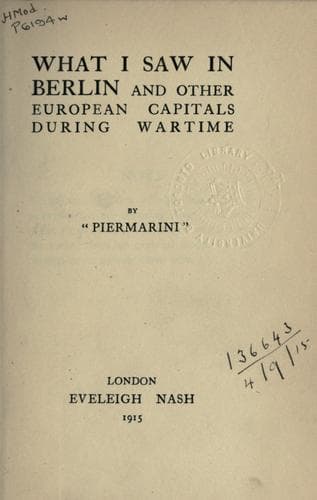
What I Saw in Berlin and Other European Capitals During WartimePiermarini
History
What I Saw in Berlin and Other European Capitals During Wartime
Piermarini
Europe -- Description and travel; World War, 1914-1918 -- Personal narratives
Italy, he is quite certain, will decide to join Germany before long.
Is she not the motherland of Machiavelli, and Machiavelli, we all
know, was decidedly against any form of neutrality. Neutrals, said the
lecturer, will be hated by the beaten nations at the end of the war
and despised by the victors.
Therefore Italy will join the German side, and the old ideal of the
German Empire (as wrote Bernhardi) will again come to life in a
federation of Germany, Austria, and Italy.
I wonder if, in a few months' time, this delightful Mr. Blüthner will
be of the same opinion?
CHAPTER VI
VIENNA
During my first visit to Berlin travel by railway was almost
impossible, so slow, crowded, and irregular was the service at that
time. Now it has been completely restored, and, if anything, probably
better than it ever was, thanks to the small number of passengers. Even
dining and sleeping cars are obtainable on the principal lines.
In the train which took me from Berlin to Vienna the civilian
passengers were no more than half a dozen; all the other passengers
were officers and soldiers, mostly wounded Austrians returning to their
motherland. Some were very seriously injured and groaned continuously;
others had horrible wounds badly bandaged; some were disfigured; some
had had limbs amputated.
They begged from the other passengers a few coppers to buy fruits or
cigars, but hardly anybody took any notice of them. They were nearly
all cavalrymen, and, as is usual in Austrian regiments, were of
different nationalities. This explains the lack of fellowship among
them--the lack of a sentiment which generally so much sustains soldiers
of other nations.
At a frontier station we were able to buy some Austrian papers.
They gave us a sort of foretaste of life in Vienna. There was very
little news, but talk about wonderful victories in Galicia and Serbia
(official), followed by a long white space where a comment had been cut
out by the Censor.
Two hours before publication a complete proof of every Austrian
paper must be presented to the Censor. Anything not considered fit
for publication is cut away; consequently the paper is often much
ornamented with blank spaces.
The big station at Vienna presents a really astonishing sight. Wounded
soldiers and refugees are everywhere. Outside the station it is the
same--and it is the same in the large central streets, in the parks, in
the churches. Vienna is the first great town completely transformed by
the war that I have seen.
On the broad footways at the sides of the streets there are two
unending processions of tired, famished-looking refugees. Most of them
are from Galicia, but there are thousands also from other provinces of
the Empire.
The authorities do not know where to place them; they do not know what
to do. They make the refugees walk with all that they still possess on
their shoulders. Often a sack and an old chair or some other piece of
furniture will be carried about for days and days.
Public-domain text, read in full here on John Shaqi.
Reviews
Reviews
No reviews yet
Be the first to share your thoughts on this work.
Elsewhere in the archive
Join the Discussion
Join the discussion
Sign in to leave a comment or review.
Sign InorCreate an account