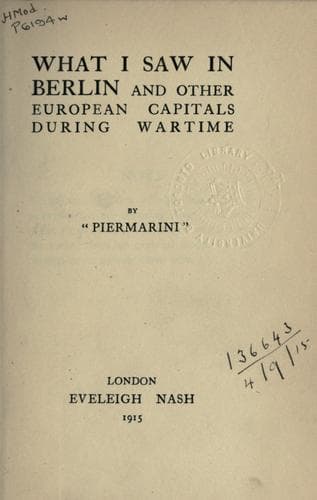
What I Saw in Berlin and Other European Capitals During WartimePiermarini
History
What I Saw in Berlin and Other European Capitals During Wartime
Piermarini
Europe -- Description and travel; World War, 1914-1918 -- Personal narratives
These people have the eyes of those who have seen the horrors of war
without knowing what it is all about, without asking or being able to
understand why their fields should be destroyed, their houses burned,
and their pacific existences overturned by the calamity. Vienna does
not know what to do with them.
The subscription list started for the refugees has not been successful,
and Vienna is invaded by an enormous number of women, children, and old
men, penniless, without clothes, and with no means of subsistence. It
is very difficult to suggest a solution to such a condition of things.
The Government has sent 60,000 to 70,000 of the fugitives to towns in
the west; but there the same phenomenon repeats itself on a smaller
scale.
The first effect of such a condition of things is the enormous increase
in the prices of foodstuffs. Milk, potatoes, meat, sugar, etc., are
double the usual price; eggs have become a food for the rich, and
bread, even of very bad quality, is expensive and scarce.
Special decrees have been issued with the purpose of restricting the
use of flour to no more than 50 per cent. in bread and 60 per cent. in
cakes, which are not allowed to be made, even in private houses, more
often than twice a week.
In the restaurants almost every dish has become more expensive, and
there are no more dinners at fixed prices.
Coal is a luxury, it being an absolute impossibility to get any from
the Westphalian mines. Gas has nearly doubled in price, and poor people
who could not pay their bills had it cut off immediately.
Most of the hotels are full of families of the Galician aristocracy.
These families seem to be living a very gay, frivolous, and expensive
life. Smart carriages and motor cars run about the streets that are
full of starving people; while ladies, in £1,000 furs, and gentlemen,
smoking half-sovereign cigars, lounge about the hotels. I have never in
my life seen a more insolent and less appropriate display of wealth.
The rich Galicians show no inclination to help the poorer refugees. "We
are refugees, too," they say.
Outside the stations I saw a crowd of people waiting for soldiers to
arrive. Having lost faith in what the newspapers say, and aching for
news, the population is trying to get it directly from those coming
from the front. Nearly all the decently dressed Viennese people wear
mourning and nearly all have the armlet of the Red Cross.
The number of wounded in Vienna is astonishing. All the schools, public
buildings, assembly rooms, most of the theatres and halls, and even
some of the pavilions which generally shelter picture shows and other
attractions, including the famous Circus, have been converted into
hospitals. All the Viennese are trying to nurse soldiers to the best of
their ability; but everything is scarce, from bandages to medicines,
from cotton wool to beds and litters.
Public-domain text, read in full here on John Shaqi.
Reviews
Reviews
No reviews yet
Be the first to share your thoughts on this work.
Elsewhere in the archive
Join the Discussion
Join the discussion
Sign in to leave a comment or review.
Sign InorCreate an account