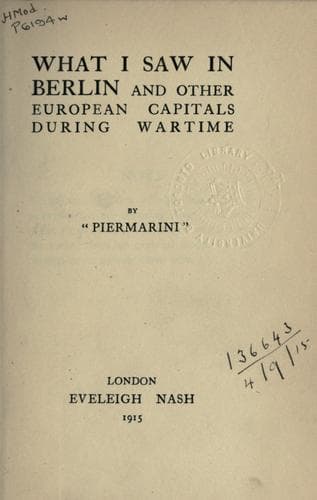
What I Saw in Berlin and Other European Capitals During WartimePiermarini
History
What I Saw in Berlin and Other European Capitals During Wartime
Piermarini
Europe -- Description and travel; World War, 1914-1918 -- Personal narratives
Though the Swiss recruit has a very short training, he is quite
effective as a soldier. As a schoolboy he has a proper physical
training, and when he leaves school he generally joins a rifle club. At
twenty he is liable to military service, which for every Swiss lasts
a period of twenty-five years. During the first year he is called out
for recruits' service, which in the infantry lasts forty-five days, in
the cavalry eighty days, and in the field artillery fifty-five days.
On completing his first year he joins the Élite, or active army, and
remains in it for twelve years. On leaving the Élite men pass to the
Landwehr, in which they remain until their twenty-fifth year of service.
A third line of troops for home defence is furnished by the Landsturm,
which is composed of all able-bodied citizens between the ages of
seventeen and fifty who are not embodied in the Élite or Landwehr.
The Federal Army thus constructed may be said in round numbers to
consist of:--Élite, 135,000; Landwehr, 82,000; and Landsturm, 63,000;
total, 280,000--an astonishing figure if one considers the total
population of Switzerland and how cheaply this army is obtained.
* * *
Before the beginning of this war one must admit there was a sort of
ill-feeling in the Swiss Confederation against France. To protect her
national industries the Republic used to be very strict on the subject
of imports from Switzerland, and the custom tariffs for exportation of
goods to France used to be much higher than those upon exports into
Germany or Italy. Since the war broke out everything has changed; the
example of Belgium and of what happened to that unfortunate nation,
for the sole reason that she was "in the way of the Germans," has made
Switzerland think how analogous is her own situation with the situation
of Belgium.
The so-called "verbal treaty" existing with Germany stood little chance
of being respected after the way in which the regular treaty with
Belgium had been violated.
At the very beginning of the campaign there was great fear of France
trying to pass through Switzerland, fear increased artificially by the
Swiss Press, which has always been frankly in favour of Germany. But
now the Swiss population begins to realise how things are really going,
and their attitude is really and strictly neutral.
It appears that the respect and ingratiating attitude towards Germany
shown by Switzerland at the beginning of the war was the usual
behaviour of the small weak boy towards the school bully. Moreover,
there was some excuse for this. It is very difficult to obtain any
papers other than German in Switzerland, and all the calumnies printed
in them were taken by the Swiss population for gospel truth.
Now some of the Berne papers begin to show a little more independence,
and print side by side the different official _communiqués_ of the
various nations.
Public-domain text, read in full here on John Shaqi.
Reviews
Reviews
No reviews yet
Be the first to share your thoughts on this work.
Elsewhere in the archive
Join the Discussion
Join the discussion
Sign in to leave a comment or review.
Sign InorCreate an account