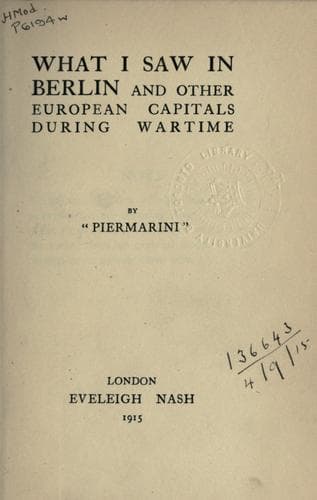
What I Saw in Berlin and Other European Capitals During WartimePiermarini
History
What I Saw in Berlin and Other European Capitals During Wartime
Piermarini
Europe -- Description and travel; World War, 1914-1918 -- Personal narratives
The Government has begun to think seriously about the food supply
question. Supposing Italy should go to war--which, it is realised, may
quite well happen any day--what would happen to Switzerland, surrounded
by Germany, Austria, France, and Italy? Where could she get the
foodstuffs she is bound to import?
Large depôts and stores of all kinds have been arranged, and severe
measures have been taken against contraband runners, who up to October
last were carrying on extensive operations. The Government has
monopolised the mills and the whole of the wheat reserves, as well as
all imports, which are taken up by the Government and sold at standard
prices and in no larger quantities than is absolutely indispensable.
All the Swiss people I came across seemed to be occupied more by
their commercial interests, badly hit as they are by the war, than by
anything else. They only wish for the war to cease, the sooner the
better.
There are hardly any foreigners in Switzerland, though some Swiss
hotel-keepers have been advertising both in England and Germany: in
England that the German managers and waiters had been removed; in
Germany that no English guests would be received in their hotels.
However, business was very slack, and everybody seemed very pessimistic
about the coming summer season.
Though the sentence, "Politically we have nothing to get and nothing to
lose," is often repeated, I met somebody who showed me that the great
crisis has awakened hopes of national development even in this quiet,
business-like little country.
At the Bubenberg, a large Berne café of world-wide fame, I met a Swiss
ex-officer whose white hair saved him from the danger of the Landsturm
service. In front of him, on the marble table, a large map of East
Switzerland was wide open, and he was tracing a few mysterious lines
on it with a blue pencil. When I asked him about it, he told me that
the north frontier of Switzerland could never be safe unless it was a
"natural" one.
"Our canton of Shaffausen," said he, "is completely isolated
among German land. We want this little piece of territory between
Ludnigshafen, on the Boden-see, and Bargen. We want also the Wutach
frontier, from the spot where this river marks our frontier with
Germany down to the Rhine."
"And what about your neutrality?" I asked him.
"Oh, the neutrality, _mon ami_, could not mean much in a general
modification of the European map; and beside that, _vous savez l'apetit
vient en mangeant_; and if everybody has a piece of Germany, why should
we keep out of the feast?"
It will be just a hundred years next September since the Prussian
Principality of Neuchatel became a Swiss canton. Well, after all, the
old Swiss captain's idea would be a rather smart way of celebrating a
centenary.
CHAPTER VIII
ITALY
Public-domain text, read in full here on John Shaqi.
Reviews
Reviews
No reviews yet
Be the first to share your thoughts on this work.
Elsewhere in the archive
Join the Discussion
Join the discussion
Sign in to leave a comment or review.
Sign InorCreate an account