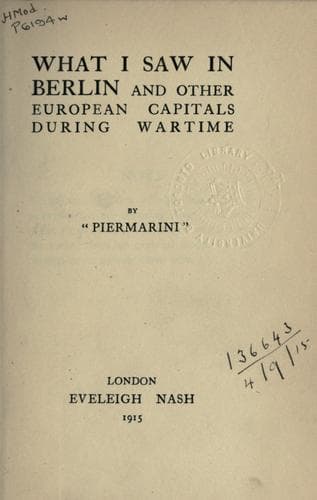
What I Saw in Berlin and Other European Capitals During WartimePiermarini
History
What I Saw in Berlin and Other European Capitals During Wartime
Piermarini
Europe -- Description and travel; World War, 1914-1918 -- Personal narratives
In the meantime, the Government proceeded to look after the defensive
works, and the mobilisation, which was thought at the beginning of the
war to be a temporary measure, became a permanent thing. In Holland,
before the war, a soldier or an officer was a curiosity. I remember
that during my first visit, years ago, I wanted to see the different
uniforms of the Dutch Army, but could never manage to do so, so scarce
were the soldiers. Even at the Hague one used to see very few officers,
and I remember asking a Dutch friend, "Where do you keep your army,
please?" To which he answered, "I am not quite certain if we have one!"
Now soldiers are everywhere, and good, solid, sturdy soldiers they
look too. I saw them drilling in the grounds near Haarlem, on the long
straight avenue that leads to Scheveningen, in the narrow lanes which
run by the side of the canals, and I received the most favourable
impression.
But the element _Man_ is necessarily of secondary importance in the
defence of a country like Holland. The only effective system of
protecting her well-developed frontiers is by fortifications, and to
this Holland has turned her attention long since. During the last forty
years the Dutch Government has carried out, at great expense, the
construction of a line of forts, complete with channels, blockhouses,
and redoubts, all along the German and Belgian frontiers.
Recently these forts were all armed with modern guns, and the capital,
Amsterdam, was also fortified in a modern and efficient manner.
But this does not mean that the defence of the country would be carried
out without much trouble; on the contrary, if Holland went to war,
the forts would offer a temporary resistance against the gigantic
modern artillery, and then the sluices would be opened and the whole
of the country, with the exception of a few eastern provinces, would
be covered by the water of the Zuyder Zee, the level of which, as
everybody knows, is higher than the level of Holland. The towns and
villages would be kept out of water by means of a system of strategic
dykes, and the country would probably resist for a long period.
But what an enormous price Holland would have to pay! The century-long
work which has transformed a sea-bed into the productive, modern
Holland would be completely wasted. For years and years to come the
industrial life of Holland would be spoiled, and it is almost certain
that the little kingdom, instead of being one of the richest, would
become one of the poorest countries on earth.
This is certainly one of the many reasons why Holland does all she
possibly can to remain neutral.
Up to the present she has succeeded in the difficult task, thanks not
only to the action of her Government, but also to the behaviour of her
subjects.
Public-domain text, read in full here on John Shaqi.
Reviews
Reviews
No reviews yet
Be the first to share your thoughts on this work.
Elsewhere in the archive
Join the Discussion
Join the discussion
Sign in to leave a comment or review.
Sign InorCreate an account