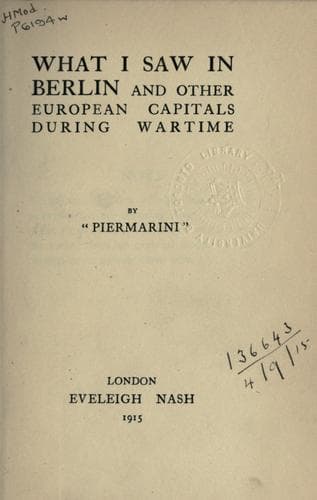
What I Saw in Berlin and Other European Capitals During WartimePiermarini
History
What I Saw in Berlin and Other European Capitals During Wartime
Piermarini
Europe -- Description and travel; World War, 1914-1918 -- Personal narratives
When you speak to a Dutchman who happens to have been near the frontier
and to have spoken to Belgian refugees, he may let himself go and use
a bitter phrase against Germany, but he will suddenly stop with the
sentence: "Of course, I am a neutral, and this does not really concern
me."
It is wonderful to see how the single individual understands the
fragility of his country, which reminds one of the earthenware pitcher
travelling with the bronze vase. Even when he had to suffer personally
from German manners (and many inhabitants of Holland trading with
Belgium were treated in the most disgusting way), the Dutchman will
generally add, as a sort of excuse, after relating his adventures:
"But, of course, they are at war, and probably one cannot help doing
such things even to neutrals when one's country is at war."
* * *
If Holland is "the most neutral of neutral States," it does not mean
that the war is not felt financially in the country. In Amsterdam a
member of the Chamber of Commerce told me that Holland's trade since
the war began has been reduced gradually by more than 65 per cent., and
that this figure is continually mounting higher.
Moreover, the refugees from Belgium who have found asylum in the
western provinces cost the nation a fair amount of money, not to
consider the expense of the fully-mobilised army's upkeep and the high
prices paid for the hurried fortification works carried out since the
beginning of the war.
"Dutch people are said to have made a good deal of money out of
Germany, up to December or even later, by selling her foodstuffs and
other articles at very high prices," I remarked, remembering what I had
heard both in England and Germany.
"Somebody certainly has," admitted the Dutchman. "Since August, 1914,
our Government has stopped the exportation of wheat, etc., but some
German private agents used to buy it and send it to private addresses
in Germany; we really don't know what happened to that stuff, and as
the prices offered by the Germans were very good, I know that a lot of
merchants here were only too glad to make business with them. Now the
new customs regulations have completely stopped this, and I can tell
you that lately Germany has not managed to get anything through the
frontiers. The German agents are still here, as well as in Rotterdam
and other towns, but they have realised that it is impossible to send
to Germany the foodstuffs, etc., which they have already stored for the
purpose, and now they have stopped buying."
* * *
Public-domain text, read in full here on John Shaqi.
Reviews
Reviews
No reviews yet
Be the first to share your thoughts on this work.
Elsewhere in the archive
Join the Discussion
Join the discussion
Sign in to leave a comment or review.
Sign InorCreate an account