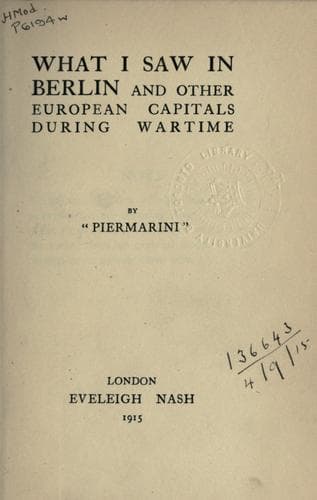
What I Saw in Berlin and Other European Capitals During WartimePiermarini
History
What I Saw in Berlin and Other European Capitals During Wartime
Piermarini
Europe -- Description and travel; World War, 1914-1918 -- Personal narratives
The complicated landing formalities distract my attention from the
contemplation of this cemetery of ships. We are searched three times.
Every scrap of paper in our pockets, every single article in our
luggage, is carefully examined. Then our passports. Very few of these
seem complete enough to please the German authorities. A man who is
travelling with somebody else's pass is discovered and taken away.
Two ladies are not allowed to land, and they are taken back on board
screaming and crying; in two days they will be sent back to Holland.
Only German is spoken here, though nearly all the officials know French
perfectly. If one does not understand German, one cannot possibly get
on. After a couple of hours we are allowed to go into the town. No more
taxi-cabs are running owing to the shortage of petrol, and also to the
fact that all vehicles have been taken up by the German Government. The
town is dark for fear of an aerial attack. Patrols of Landsturm men
pass continuously across the principal street, and fill the town with
the squeaky noise of their nailed boots. The password is loudly shouted
when they meet another patrol.
At the hotel everybody is German, from the manager to the liftman and
to the chambermaids. As for the guests, they are all German officers.
Every good hotel in Belgium is at the present moment inhabited almost
exclusively by German officers, and outside the main doors a white,
black, and red striped sentry-box has taken the place of the majestic
doorkeeper.
Most of the officers are not alone; they have sent for their wives, and
very often even their children, nursemaids, servants, and dogs.
I am told the German Government is encouraging this kind of thing,
and offers special travel facilities for wives and families. Lately
non-commissioned officers and men have been allowed to send for their
families. I don't know the real reason of all this, but it is certain
that the Germans are trying hard to give the Belgians the impression
that they have come to stay. In many places they have taken houses or
flats for a year, and have paid for them in advance, and in some small
towns in which it is not possible to get a comfortable residence they
have started the construction of new villas and cottages.
I walk down the Avenue de Keyzer and enter a very large restaurant,
which seems also completely in German hands. Even the menu is printed
in German, and hardly a single Belgian enters the huge establishment. I
ask for some newspapers, and I am told they can only get German ones;
at ten o'clock every light must be out. People walking in the street
without special permits after half-past ten are likely to be arrested.
Public-domain text, read in full here on John Shaqi.
Reviews
Reviews
No reviews yet
Be the first to share your thoughts on this work.
Elsewhere in the archive
Join the Discussion
Join the discussion
Sign in to leave a comment or review.
Sign InorCreate an account