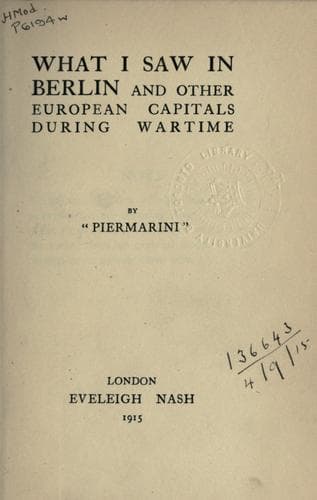
What I Saw in Berlin and Other European Capitals During WartimePiermarini
History
What I Saw in Berlin and Other European Capitals During Wartime
Piermarini
Europe -- Description and travel; World War, 1914-1918 -- Personal narratives
The Germans at Louvain did the same thing, but they beat the Romans.
Every third man was the victim. I met a gentleman who had been twice
through this ordeal. He was still young, but his hair was grey, and
his eyes had in them a far-off expression of terror. Near the cathedral
somebody pointed out to me a young woman gone mad through having lost
her husband and brother in this way.
* * *
From Louvain to Malines the country shows all the signs of dreadful
desolation. Flooded land covered with ice, under which the dead lie by
hundreds, pieces of wood crowned by Belgian képis or Prussian helmets
marking the grave of officers--this is the sight. Flooded trenches
and rusty wirework, burned or cut trees, telegraphic poles smashed by
shells, and again burned houses and windmills, some of the large wings
of which have been amputated, and little ruined châteaux on the top of
which waves a German flag.
The train passes the Dyle on a temporary bridge constructed at the side
of the old one destroyed by the retreating Belgians. Here were many
large greenhouses in which the cultivation of the orchid had reached
its highest degree of perfection. Now they look like enormous cages,
every one of their windows having been smashed.
Malines station gives you an idea of what the whole town looks like.
A large placard tells you that the town is now called Mecheln, and
underneath it is a large picture of the general who ordered the
shelling of the town, but met his death the same day. German soldiers
keep the frame constantly decorated with laurel branches. The glass
roof is torn by an enormous hole, through which the snow enters freely.
The waiting-room has also an extra aperture, and a bomb has taken
away every bit of the stucco work and left the walls completely bare.
Malines was not set on fire; all the ruin brought on it was due to
the blind violence of the high explosives. Evidently they are not as
destructive as the people who have invented them, and the town does not
look half as bad as Louvain.
Though very few of the houses are untouched, the general aspect of the
quiet town has not changed much. Only one or two of the large domes and
steeples which used to emerge from the roofs of the small houses have
disappeared, and the unfinished tower of St. Rombaut has altered its
massive silhouette a little.
Now and again I see deep holes, caused by shells, and houses which
have lost a corner, and allow a glance of their domestic life through
a large crevice. Here a quiet "béguinage" has received a projectile
in full, and from the street I can see a whitewashed room with a
decapitated painted crucifix, and hanging to a nail a black bonnet of
the old Brabant country woman.
Public-domain text, read in full here on John Shaqi.
Reviews
Reviews
No reviews yet
Be the first to share your thoughts on this work.
Elsewhere in the archive
Join the Discussion
Join the discussion
Sign in to leave a comment or review.
Sign InorCreate an account