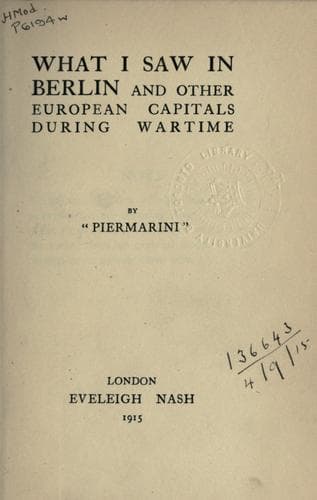
What I Saw in Berlin and Other European Capitals During WartimePiermarini
History
What I Saw in Berlin and Other European Capitals During Wartime
Piermarini
Europe -- Description and travel; World War, 1914-1918 -- Personal narratives
Outside, the streets are nearly deserted. A few soldiers, a few
ragged people begging for a copper or a piece of bread, these I see;
a few of the old inhabitants searching the remains of their homes and
contemplating, with the look of somebody who sees an old friend, every
bit of metal, every fragment of pottery they happen to find. They have
constructed temporary shelters and collected therein what the flames
have spared. Some are looking under their house ruins for a member of
the family who has disappeared. Every day a new corpse is found. In
every square are fresh graves, and the very day of my visit five more
victims of German violence had been buried right in the middle of the
station square, all round the statue of Van der Weyer, which has been
respected probably as an homage to its ugliness. The Kommandant of
Louvain insisted that the victims should be buried there, and not in
the cemetery, "to set a good example!"
In this phrase is the reason of the destruction of the harmless little
town--a reason which has puzzled the whole world.
For the most dreadful part of the destruction of Louvain is that
there has been no fighting, no shelling, nothing of what we generally
understand by the word war. The town had been quietly occupied by the
Germans, and they forced the population to leave their houses without
carrying anything with them. People who tried to save anything were
robbed of what they had taken with them, the earrings were pulled out
of the women's ears (I have seen a body with both the ear-lobes torn in
two), the pockets searched, and in more than one case anybody who was
found to be carrying something was immediately shot.
Petrol and some other new liquid combustible quite recently discovered
in a Berlin laboratory, and which the Louvain people have christened
"Colofogne du Diable," were poured abundantly on the whole town,
except, perhaps, on twenty houses inhabited by Germans. I saw, in
one of the station rooms, the fire engines which have been used for
this purpose, fire engines which bear the arms of the City of Louvain,
and which, with cruel irony, were used to set fire to the town they
had been created to save. Specially made bombs were thrown into every
house, and the Germans retired outside the town on the great boulevard
to enjoy a spectacle really worthy of Nero.
But at Louvain the Germans have surpassed Nero. While the town was
still burning all the population, regardless of age or sex, was
arranged in a single line near Mont César. And then the most dreadful
thing happened.
The Romans, to subdue soldiers' rebellions, invented a punishment which
always seemed to the world the limit of cruelty--decimation.
Public-domain text, read in full here on John Shaqi.
Reviews
Reviews
No reviews yet
Be the first to share your thoughts on this work.
Elsewhere in the archive
Join the Discussion
Join the discussion
Sign in to leave a comment or review.
Sign InorCreate an account