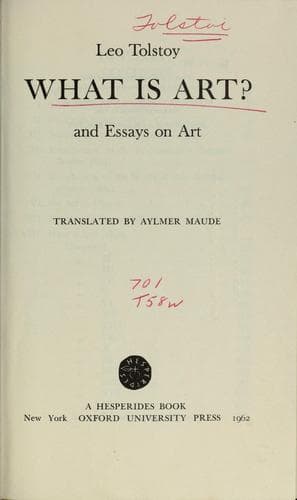
Tolstoy does not shrink from condemning his own artistic productions;
with the exception of two short stories, he tells us they are works of
bad art. Take, for instance, the novel _Resurrection_, which is now
appearing, and of which he has, somewhere, spoken disparagingly, as
being “written in my former style,” and being therefore bad art. What
does this mean? The book is a masterpiece in its own line; it is eagerly
read in many languages; it undoubtedly infects its readers, and the
feelings transmitted are, in the main, such as Tolstoy approves of—in
fact, they are the feelings to which his religious perception has
brought him. If lust is felt in one chapter, the reaction follows as
inevitably as in real life, and is transmitted with great artistic
power. Why a work of such rare merit does not satisfy Tolstoy, is
because it is a work of “exclusive art,” laden with details of time and
place. It has not the “simplicity and compression” necessary in works of
“universal” art. Things are mentioned which might apparently be quite
well omitted. The style, also, is not one of great simplicity; the
sentences are often long and involved, as is commonly the case in
Tolstoy’s writings. It is a novel appealing mainly to the class that has
leisure for novel reading because it neglects to produce its own food,
make its own clothes, or build its own houses. If Tolstoy is stringent
in his judgment of other artists, he is more stringent still in his
judgment of his own artistic works. Had _Resurrection_ been written by
Dickens, or by Hugo, Tolstoy would, I think, have found a place for it
(with whatever reservations) among the examples of religious art. For
indeed, strive as we may to be clear and explicit, our approval and
disapproval is a matter of degree. The thought which underlay the
remark: “Why callest thou me good? none is good, save one, even God,”
applies not to man only, but to all things human.
_What is Art?_ itself is a work of science—though many passages, and
even some whole chapters, appeal to us as works of art, and we feel the
contagion of the author’s hope, his anxiety to serve the cause of truth
and love, his indignation (sometimes rather sharply expressed) with what
blocks the path of advance, and his contempt for much that the “cultured
crowd,” in our erudite, perverted society, have persuaded themselves,
and would fain persuade others, is the highest art.
Public-domain text, read in full here on John Shaqi.
Reviews
Reviews
No reviews yet
Be the first to share your thoughts on this work.
Join the Discussion
Join the discussion
Sign in to leave a comment or review.
Sign InorCreate an account