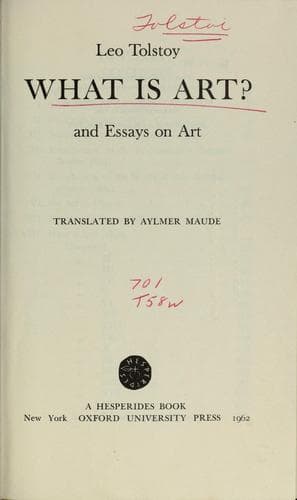
But here is a book that obliges us to clear our minds. It challenges us
to define “art” and “beauty,” and to say why we consider these things,
that pleased us, to be specially important. And as to beauty, we find
that the definition given by æsthetic writers amounts merely to this,
that “Beauty is a kind of pleasure received by us, not having personal
advantage for its object.” But it follows from this, that “beauty” is a
matter of taste, differing among different people, and to attach special
importance to what pleases _me_ (and others who have had the same sort
of training that I have had) is merely to repeat the old, old mistake
which so divides human society; it is like declaring that my race is the
best race, my nation the best nation, my church the best church, and my
family the “best” family. It indicates ignorance and selfishness.
But “truth angers those whom it does not convince;”—people do not wish
to understand these things. It seems, at first, as though Tolstoy were
obliging us to sacrifice something valuable. We do not realise that we
are being helped to select the best art, but we do feel that we are
being deprived of our sense of satisfaction in Rudyard Kipling.
Both the magnitude and the difficulty of the task were therefore very
great, but they have been surmounted in a marvellous manner. Of the
effect this book has had on me personally, I can only say that “whereas
I was blind, now I see.” Though sensitive to some forms of art, I was,
when I took it up, much in the dark on questions of æsthetic philosophy;
when I had done with it, I had grasped the main solution of the problem
so clearly that—though I waded through nearly all that the critics and
reviewers had to say about the book—I never again became perplexed upon
the central issues.
Tolstoy was indeed peculiarly qualified for the task he has
accomplished. It was after many years of work as a writer of fiction,
and when he was already standing in the very foremost rank of European
novelists, that he found himself compelled to face, in deadly earnest,
the deepest problems of human life. He not only could not go on writing
books, but he felt he could not live, unless he found clear guidance, so
that he might walk sure-footedly and know the purpose and meaning of his
life. Not as a mere question of speculative curiosity, but as a matter
of vital necessity, he devoted years to rediscover the truths which
underlie all religion.
Public-domain text, read in full here on John Shaqi.
Reviews
Reviews
No reviews yet
Be the first to share your thoughts on this work.
Join the Discussion
Join the discussion
Sign in to leave a comment or review.
Sign InorCreate an account