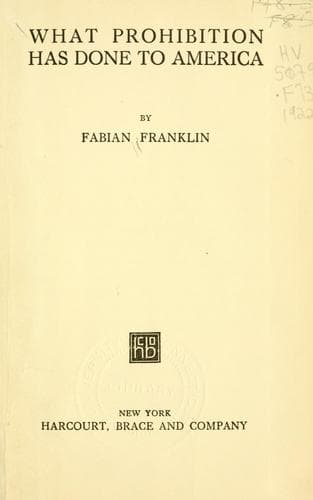
What Prohibition Has Done to AmericaFranklin, Fabian
History
What Prohibition Has Done to America
Franklin, Fabian
Prohibition -- United States; United States. Constitution. 18th Amendment
fellow-creatures and those who sought to save mankind from perdition.
That the millions of people who enjoyed drinking, to whom it was a
cherished source of refreshment, recuperation, and sociability, had
any stake in the matter, the agitators never for a moment
acknowledged; if a man stood out against Prohibition he was not the
champion of the millions who enjoyed drink, but the servant of the
interests who sold drink. This preposterous fiction was allowed to
pass current with but little challenge; and many a public man who
might have stood out against the Anti-Saloon League's power over the
ballot-box cowered at the thought of the moral reprobation which a
courageous stand against Prohibition might bring down upon him. Thus
the swiftness with which the Prohibition Amendment was adopted by
Congress and by State Legislatures, and the overwhelming majorities
which it commanded in those bodies, is no proof either of sincere
conviction on the part of the lawmakers or of their belief that they
were expressing the genuine will of their constituents. As for
individual conviction, the personal conduct of a large proportion of
the lawmakers who voted for Prohibition is in notorious conflict with
their votes; and as for the other question, it has happened in State
after State that the Legislature was almost unanimous for Prohibition
when the people of the State had quite recently shown by their vote
that they were either distinctly against it or almost evenly divided.
Of this kind of proceeding, Maryland presented an example so flagrant
as to deserve special mention. Although popular votes in the State
had, within quite a short time, recorded strong anti-Prohibition
majorities, the Legislature rushed its ratification of the Eighteenth
Amendment through in the very first days of its session; and this in
face of the fact that Maryland has always held strongly by State
rights and cherished its State individuality, and that the leading
newspapers of the State and many of its foremost citizens came out
courageously and energetically against the Amendment. In these
circumstances, nothing but a mean subserviency to political
intimidation can possibly account for the indecent haste with which
the ratification was pushed through. It is interesting to note a
subsequent episode which casts a further interesting light on the
matter, and tends to show that there are limits beyond which the
whip-and-spur rule of the Anti-Saloon League cannot go. In the session
of the present year, the Anti-Saloon League tried to get a State
Prohibition enforcement bill passed. Although there was a great public
protest, the bill was put through the lower House of the Legislature;
but in the Senate it encountered resistance of an effective kind. The
Senate did not reject the bill; but, in spite of bitter opposition by
the Anti-Saloon League, it attached to the bill a referendum clause.
With that clause attached, the Anti-Saloon League ceased to desire the
Public-domain text, read in full here on John Shaqi.
Reviews
Reviews
No reviews yet
Be the first to share your thoughts on this work.
Join the Discussion
Join the discussion
Sign in to leave a comment or review.
Sign InorCreate an account