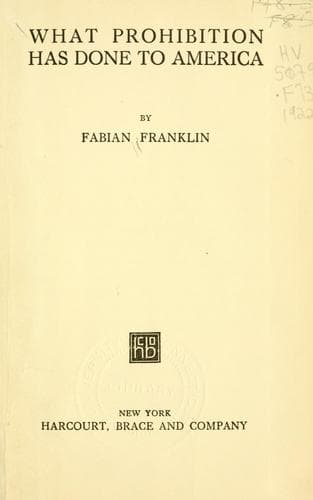
What Prohibition Has Done to AmericaFranklin, Fabian
History
What Prohibition Has Done to America
Franklin, Fabian
Prohibition -- United States; United States. Constitution. 18th Amendment
If the South had stuck to its own business and to its
traditional principle of State autonomy--a principle which the South
invokes as ardently as ever when it comes to any other phase of the
negro question--there would never have been a Prohibition Amendment to
the Constitution of the United States; and at the same time the South
would have found it perfectly possible to deal effectively with its
own drink problem by energetic execution of its own laws, made
possible by its own public opinion.
Nor is the case essentially different as regards the West; the very
people who are loudest in their shouting for the Eighteenth Amendment
are also most emphatic in their praises of what Kansas accomplished by
enforcing her own Prohibition law. Thus the Prohibitionist tyranny is
in no small measure a sectional tyranny, which is of course an
aggravated form of majority tyranny. But what needs insisting on even
more than this is the way in which the country districts impose their
notions about Prohibition upon the people of the cities, and
especially of the great cities. When attention is called to the
wholesale disregard of the law, contempt for the law, and hostility to
the law which is so manifest in the big cities, the champions of
Prohibition in the press--including the New York press--never tire of
saying that it is only in New York and a few other great cities that
this state of things exists. But everybody knows that the condition
exists not only in "a few," but in practically all, of our big cities;
and for that matter that it exists in a large proportion of all the
cities of the country, big and little. But if we confine ourselves
only to the 34 cities having a population of 200,000 or more, we have
here an aggregate population of almost exactly 25,000,000--nearly
one-fourth of the entire population of the country. Is it a trifling
matter that these great communities, this vast population of
large-city dwellers, should have their mode of life controlled by a
majority rolled up by the vote of people whose conditions, whose
advantages and disadvantages, whose opportunities and mode of life,
and consequently whose desires and needs, are of a wholly different
nature? Could the tyranny of the majority take a more obnoxious form
than that of sparse rural populations, scattered over the whole area
of the country from Maine to Texas and from Georgia to Oregon,
deciding for the crowded millions of New York and Chicago that they
shall or shall not be permitted to drink a glass of beer? Nor is it
only the obvious tyranny of such a regime that makes it so
unjustifiable. There are some special features in the case which
accentuate its unreasonableness and unfairness. In the American
village and small town, the use of alcoholic drinks presents almost no
good aspect. The countryman sees nothing but the vile and sordid side
of it. The village grogshop, the bar of the smalltown hotel, in
America has presented little but the gross and degrading aspect of
drinking.
Public-domain text, read in full here on John Shaqi.
Reviews
Reviews
No reviews yet
Be the first to share your thoughts on this work.
Join the Discussion
Join the discussion
Sign in to leave a comment or review.
Sign InorCreate an account