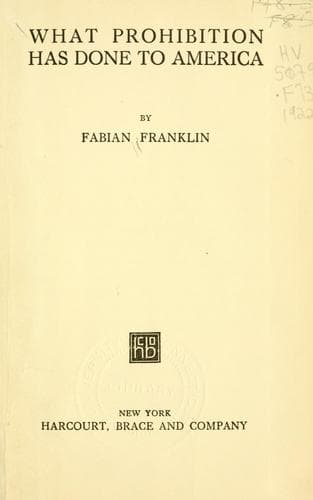
What Prohibition Has Done to AmericaFranklin, Fabian
History
What Prohibition Has Done to America
Franklin, Fabian
Prohibition -- United States; United States. Constitution. 18th Amendment
Upon the question of centralization or decentralization, of Federal
power or State autonomy, there is room for rational difference of
opinion. But upon the question whether a regulation prescribing the
personal habits of individuals forms a proper part of the Constitution
of a great nation there is no room whatever for rational difference of
opinion. Whether Prohibition is right or wrong, wise or unwise, all
sides are agreed that it is a denial of personal liberty.
Prohibitionists maintain that the denial is justified, like other
restraints upon personal liberty to which we all assent;
anti-prohibitionists maintain that this denial of personal liberty is
of a vitally different nature from those to which we all assent. That
it is a denial of personal liberty is undisputed; and the point with
which we are at this moment concerned is that to entrench a denial of
liberty behind the mighty ramparts of our Constitution is to do
precisely the opposite of what our Constitution--or any Constitution
like ours--is designed to do. The Constitution withdraws certain
things from the control of the majority for the time being--withdraws
them from the province of ordinary legislation--for the purpose of
safeguarding liberty, the Eighteenth Amendment seizes upon the
mechanism designed for this purpose, and perverts it to the
diametrically opposite end, that of safeguarding the denial of
liberty.
All history teaches that liberty is in danger from the tyranny of
majorities as well as from that of oligarchies and monarchies;
accordingly the Constitution says: No mere majority, no ordinary
legislative procedure, shall be competent to deprive the people of the
liberty that is hereby guaranteed to them. But the Eighteenth
Amendment says: No mere majority, no mere legislative procedure, shall
be competent to restore to the people the liberty that is hereby taken
away from them. Thus, quite apart from all questions as to the merits
of Prohibition in itself, the Eighteenth Amendment is a Constitutional
monstrosity. That this has not been more generally and more keenly
recognized is little to the credit of the American people, and still
less to the credit of the American press and of those who should be
the leaders of public opinion. One circumstance may, however, be cited
which tends to extenuate in some degree this glaring failure of
political sense and judgment. There have long been Prohibition
enactments in many of our State Constitutions, and this has made
familiar and commonplace the idea of Prohibition as part of a
Constitution. But our State Constitutions are not Constitutions in
anything like the same sense as that which attaches to the
Constitution of the United States. Most of our State Constitutions can
be altered with little more difficulty than ordinary laws; the process
merely takes a little more time, and offers no serious obstacle to any
object earnestly desired by a substantial majority of the people of
the State.
Public-domain text, read in full here on John Shaqi.
Reviews
Reviews
No reviews yet
Be the first to share your thoughts on this work.
Join the Discussion
Join the discussion
Sign in to leave a comment or review.
Sign InorCreate an account