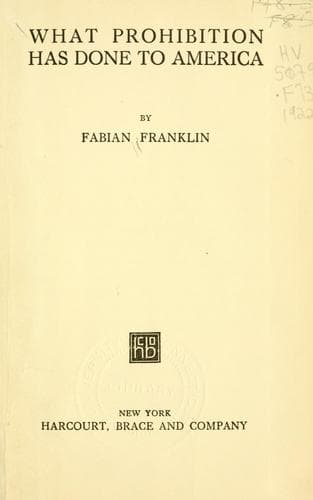
What Prohibition Has Done to AmericaFranklin, Fabian
History
What Prohibition Has Done to America
Franklin, Fabian
Prohibition -- United States; United States. Constitution. 18th Amendment
A law punishing drunkenness, which is a public nuisance, comes under
the head I have been speaking of; a law forbidding a man to drink for
fear that he may become a drunkard does not. And in fact the
prohibitionists themselves instinctively recognize the difference, and
avoid, so far as they can, offending the sense of liberty by so direct
an attack upon it. It is safe to say that if the Eighteenth Amendment
had undertaken to make the _drinking_ of liquor a crime, instead of the
_manufacture and sale_ of it, it could not have been passed or come
anywhere near being passed. There is hardly a Senator or a
Representative that would not have recoiled from a proposal so palpably
offensive to the instinct of liberty. Yet precisely this is the real
object of the Eighteenth Amendment; its purpose and, if enforced, its
practical effect is to make it permanently a crime against the national
government for an American to drink a glass of beer or wine. The
legislators, State and national, who enacted it knew this perfectly
well; yet if the thing had been put into the Amendment in so many
words, hardly a man of them would have cast his vote for it. The
phenomenon is not so strange, or so novel, as it might seem; it has a
standard prototype in the history of Rome. The Roman people had a
rooted aversion and hostility to kings; and no Caesar would ever have
thought of calling himself _rex_. But _imperator_ went down quite
smoothly, and did just as well.
In addition to its being a regulation of individual conduct in a matter
which is in its nature the individual's own concern, Prohibition
differs in another essential respect from those restrictions upon
liberty which form a legitimate and necessary part of the operation of
civil government. To put a governmental ban upon all alcoholic drinks
is to forbid the _use_ of a thing in order to prevent its _abuse_. A Of
course there are fanatics who declare--and believe--that _all_
indulgence in alcoholic drink, however moderate, is abuse; but to
justify Prohibition on that ground would be to accept a doctrine even
more dangerous to liberty. It is bad enough to justify the proscription
of an innocent indulgence on the ground that there is danger of its
being carried beyond the point of innocence; but it is far worse to
forbid it on the ground that, however innocent and beneficial a
moderate indulgence may seem to millions of people, it is not regarded
as good for them by others. The only thing that lends dignity to the
Prohibition cause is the undeniable fact that drunkenness is the source
of a vast amount of evil and wretchedness; the position of those who
declare that all objections must be waived in the presence of this
paramount consideration is respectable, though in my judgment utterly
wrong. But any man who justifies Prohibition on the ground that
drinking is an evil, no matter how temperate, is either a man of narrow
and stupid mind or is utterly blind to the value of human liberty. The
Public-domain text, read in full here on John Shaqi.
Reviews
Reviews
No reviews yet
Be the first to share your thoughts on this work.
Join the Discussion
Join the discussion
Sign in to leave a comment or review.
Sign InorCreate an account