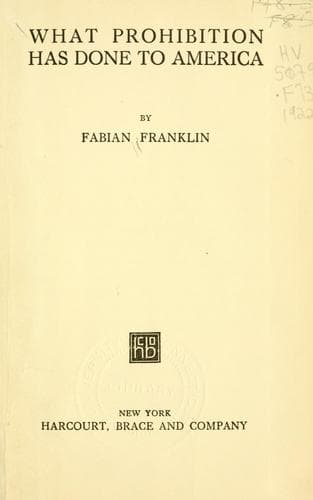
What Prohibition Has Done to AmericaFranklin, Fabian
History
What Prohibition Has Done to America
Franklin, Fabian
Prohibition -- United States; United States. Constitution. 18th Amendment
deepseated historical causes in the face of which the wisdom and
patriotism of three generations of Americans found itself powerless.
This new cleavage has been caused by an act of legislative folly
unmatched in the history of free institutions. My hope--a distant and
yet a sincere hope--is that the American people may, in spite of all
difficulties, be awakened to a realization of that folly and restore
the Constitution to its traditional dignity by a repeal, sooner or
later, of the monstrous Amendment by which it has been defaced.
CHAPTER III
DESTROYING OUR FEDERAL SYSTEM
THUS far I have been dealing with the wrong which the Prohibition
Amendment commits against the vital principle of any national
Constitution, the principle which alone justifies the idea of a
Constitution--a body of organic law removed from the operation of the
ordinary processes of popular rule and representative government. But
reference was made at the outset to a wrong of a more special, yet
equally profound, character. The distinctive feature of our system of
government is that it combines a high degree of power and independence
in the several States with a high degree of power and authority in the
national government. Time was when the dispute naturally arising in
such a Federal Union, concerning the line of division between these
two kinds of power, turned on an abstract or legalistic question of
State sovereignty. That abstract question was decided, once for all,
by the arbitrament of arms in our great Civil War. But the decision,
while it strengthened the foundations of the Federal Union, left
unimpaired the individuality, the vitality, the self-dependence of the
States in all the ordinary affairs of life. It continued to be true,
after the war as before, that each State had its own local pride,
developed its own special institutions, regulated the conduct of life
within its boundaries according to its own views of what was conducive
to the order, the well-being, the contentment, the progress, of its
own people. It has been the belief of practically all intelligent
observers of our national life that this individuality and
self-dependence of the States has been a cardinal element in the
promotion of our national welfare and in the preservation of our
national character. In a country of such vast extent and natural
variety, a country developing with unparalleled rapidity and
confronted with constantly changing conditions, who can say how great
would have been the loss to local initiative and civic spirit, how
grave the impairment of national concord and good will, if all the
serious concerns of the American people had been settled for them by a
central government at Washington ? In that admirable little book,
"Politics for Young Americans," Charles Nordhoff fifty years ago
expounded in simple language the principles underlying our system of
government. Coming to the subject of "Decentralization," he said:
Public-domain text, read in full here on John Shaqi.
Reviews
Reviews
No reviews yet
Be the first to share your thoughts on this work.
Join the Discussion
Join the discussion
Sign in to leave a comment or review.
Sign InorCreate an account