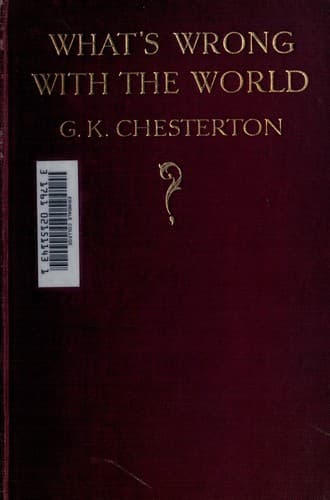
What's Wrong with the WorldChesterton, G. K. (Gilbert Keith)
Philosophy
What's Wrong with the World
Chesterton, G. K. (Gilbert Keith)
Social problems
Some people do not like the word “dogma.” Fortunately they are free, and
there is an alternative for them. There are two things, and two things
only, for the human mind, a dogma and a prejudice. The Middle Ages
were a rational epoch, an age of doctrine. Our age is, at its best, a
poetical epoch, an age of prejudice. A doctrine is a definite point; a
prejudice is a direction. That an ox may be eaten, while a man should
not be eaten, is a doctrine. That as little as possible of anything
should be eaten is a prejudice; which is also sometimes called an ideal.
Now a direction is always far more fantastic than a plan. I would
rather have the most archaic map of the road to Brighton than a general
recommendation to turn to the left. Straight lines that are not parallel
must meet at last; but curves may recoil forever. A pair of lovers might
walk along the frontier of France and Germany, one on the one side and
one on the other, so long as they were not vaguely told to keep away
from each other. And this is a strictly true parable of the effect of
our modern vagueness in losing and separating men as in a mist.
It is not merely true that a creed unites men. Nay, a difference of
creed unites men--so long as it is a clear difference. A boundary
unites. Many a magnanimous Moslem and chivalrous Crusader must have been
nearer to each other, because they were both dogmatists, than any two
homeless agnostics in a pew of Mr. Campbell’s chapel. “I say God is
One,” and “I say God is One but also Three,” that is the beginning of a
good quarrelsome, manly friendship. But our age would turn these creeds
into tendencies. It would tell the Trinitarian to follow multiplicity as
such (because it was his “temperament”), and he would turn up later with
three hundred and thirty-three persons in the Trinity. Meanwhile, it
would turn the Moslem into a Monist: a frightful intellectual fall. It
would force that previously healthy person not only to admit that there
was one God, but to admit that there was nobody else. When each had, for
a long enough period, followed the gleam of his own nose (like the Dong)
they would appear again; the Christian a Polytheist, and the Moslem a
Panegoist, both quite mad, and far more unfit to understand each other
than before.
Public-domain text, read in full here on John Shaqi.
Reviews
Reviews
No reviews yet
Be the first to share your thoughts on this work.
Join the Discussion
Join the discussion
Sign in to leave a comment or review.
Sign InorCreate an account