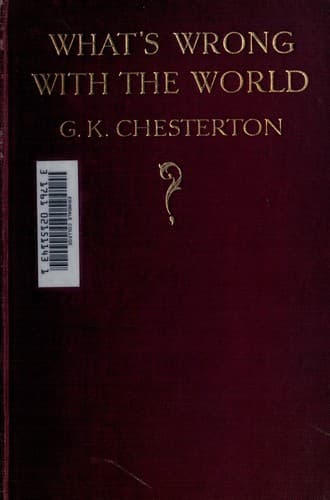
What's Wrong with the WorldChesterton, G. K. (Gilbert Keith)
Philosophy
What's Wrong with the World
Chesterton, G. K. (Gilbert Keith)
Social problems
The things philanthropists barely excuse (or do not excuse) in the life
of the laboring classes are simply the things we have to excuse in all
the greatest monuments of man. It may be that the laborer is as gross as
Shakespeare or as garrulous as Homer; that if he is religious he talks
nearly as much about hell as Dante; that if he is worldly he talks
nearly as much about drink as Dickens. Nor is the poor man without
historic support if he thinks less of that ceremonial washing which
Christ dismissed, and rather more of that ceremonial drinking which
Christ specially sanctified. The only difference between the poor man of
to-day and the saints and heroes of history is that which in all classes
separates the common man who can feel things from the great man who can
express them. What he feels is merely the heritage of man. Now nobody
expects of course that the cabmen and coal-heavers can be complete
instructors of their children any more than the squires and colonels and
tea merchants are complete instructors of their children. There must be
an educational specialist in loco parentis. But the master at Harrow is
in loco parentis; the master in Hoxton is rather contra parentem. The
vague politics of the squire, the vaguer virtues of the colonel, the
soul and spiritual yearnings of a tea merchant, are, in veritable
practice, conveyed to the children of these people at the English public
schools. But I wish here to ask a very plain and emphatic question. Can
anyone alive even pretend to point out any way in which these special
virtues and traditions of the poor are reproduced in the education of
the poor? I do not wish the coster’s irony to appeal as coarsely in the
school as it does in the tap room; but does it appear at all? Is
the child taught to sympathize at all with his father’s admirable
cheerfulness and slang? I do not expect the pathetic, eager pietas of
the mother, with her funeral clothes and funeral baked meats, to be
exactly imitated in the educational system; but has it any influence at
all on the educational system? Does any elementary schoolmaster accord
it even an instant’s consideration or respect? I do not expect the
schoolmaster to hate hospitals and C.O.S. centers so much as the
schoolboy’s father; but does he hate them at all? Does he sympathize
in the least with the poor man’s point of honor against official
institutions? Is it not quite certain that the ordinary elementary
schoolmaster will think it not merely natural but simply conscientious
to eradicate all these rugged legends of a laborious people, and on
principle to preach soap and Socialism against beer and liberty? In
the lower classes the school master does not work for the parent, but
against the parent. Modern education means handing down the customs of
the minority, and rooting out the customs of the majority. Instead of
their Christlike charity, their Shakespearean laughter and their high
Homeric reverence for the dead, the poor have imposed on them mere
Public-domain text, read in full here on John Shaqi.
Reviews
Reviews
No reviews yet
Be the first to share your thoughts on this work.
Elsewhere in the archive
Join the Discussion
Join the discussion
Sign in to leave a comment or review.
Sign InorCreate an account