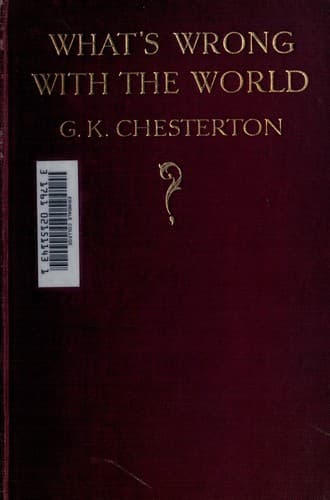
What's Wrong with the WorldChesterton, G. K. (Gilbert Keith)
Philosophy
What's Wrong with the World
Chesterton, G. K. (Gilbert Keith)
Social problems
It is admitted, one may hope, that common things are never commonplace.
Birth is covered with curtains precisely because it is a staggering
and monstrous prodigy. Death and first love, though they happen to
everybody, can stop one’s heart with the very thought of them. But while
this is granted, something further may be claimed. It is not merely true
that these universal things are strange; it is moreover true that they
are subtle. In the last analysis most common things will be found to
be highly complicated. Some men of science do indeed get over the
difficulty by dealing only with the easy part of it: thus, they will
call first love the instinct of sex, and the awe of death the instinct
of self-preservation. But this is only getting over the difficulty of
describing peacock green by calling it blue. There is blue in it. That
there is a strong physical element in both romance and the Memento
Mori makes them if possible more baffling than if they had been wholly
intellectual. No man could say exactly how much his sexuality was
colored by a clean love of beauty, or by the mere boyish itch for
irrevocable adventures, like running away to sea. No man could say how
far his animal dread of the end was mixed up with mystical traditions
touching morals and religion. It is exactly because these things are
animal, but not quite animal, that the dance of all the difficulties
begins. The materialists analyze the easy part, deny the hard part and
go home to their tea.
It is complete error to suppose that because a thing is vulgar therefore
it is not refined; that is, subtle and hard to define. A drawing-room
song of my youth which began “In the gloaming, O, my darling,” was
vulgar enough as a song; but the connection between human passion and
the twilight is none the less an exquisite and even inscrutable thing.
Or to take another obvious instance: the jokes about a mother-in-law
are scarcely delicate, but the problem of a mother-in-law is extremely
delicate. A mother-in-law is subtle because she is a thing like the
twilight. She is a mystical blend of two inconsistent things--law and a
mother. The caricatures misrepresent her; but they arise out of a real
human enigma. “Comic Cuts” deals with the difficulty wrongly, but it
would need George Meredith at his best to deal with the difficulty
rightly. The nearest statement of the problem perhaps is this: it is not
that a mother-in-law must be nasty, but that she must be very nice.
Public-domain text, read in full here on John Shaqi.
Reviews
Reviews
No reviews yet
Be the first to share your thoughts on this work.
Join the Discussion
Join the discussion
Sign in to leave a comment or review.
Sign InorCreate an account