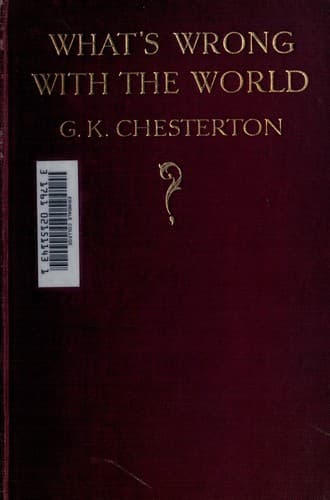
What's Wrong with the WorldChesterton, G. K. (Gilbert Keith)
Philosophy
What's Wrong with the World
Chesterton, G. K. (Gilbert Keith)
Social problems
The real truth is that adumbrated in the introductory section when we
spoke of the sense of home and property, as now we speak of the sense
of counsel and community. All men do naturally love the idea of leisure,
laughter, loud and equal argument; but there stands a specter in our
hall. We are conscious of the towering modern challenge that is called
specialism or cut-throat competition--Business. Business will
have nothing to do with leisure; business will have no truck with
comradeship; business will pretend to no patience with all the legal
fictions and fantastic handicaps by which comradeship protects its
egalitarian ideal. The modern millionaire, when engaged in the agreeable
and typical task of sacking his own father, will certainly not refer
to him as the right honorable clerk from the Laburnum Road, Brixton.
Therefore there has arisen in modern life a literary fashion devoting
itself to the romance of business, to great demigods of greed and to
fairyland of finance. This popular philosophy is utterly despotic and
anti-democratic; this fashion is the flower of that Caesarism against
which I am concerned to protest. The ideal millionaire is strong in the
possession of a brain of steel. The fact that the real millionaire is
rather more often strong in the possession of a head of wood, does not
alter the spirit and trend of the idolatry. The essential argument is
“Specialists must be despots; men must be specialists. You cannot have
equality in a soap factory; so you cannot have it anywhere. You cannot
have comradeship in a wheat corner; so you cannot have it at all. We
must have commercial civilization; therefore we must destroy democracy.”
I know that plutocrats have seldom sufficient fancy to soar to such
examples as soap or wheat. They generally confine themselves, with fine
freshness of mind, to a comparison between the state and a ship. One
anti-democratic writer remarked that he would not like to sail in a
vessel in which the cabin-boy had an equal vote with the captain. It
might easily be urged in answer that many a ship (the Victoria, for
instance) was sunk because an admiral gave an order which a cabin-boy
could see was wrong. But this is a debating reply; the essential fallacy
is both deeper and simpler. The elementary fact is that we were all
born in a state; we were not all born on a ship; like some of our great
British bankers. A ship still remains a specialist experiment, like
a diving-bell or a flying ship: in such peculiar perils the need for
promptitude constitutes the need for autocracy. But we live and die in
the vessel of the state; and if we cannot find freedom camaraderie and
the popular element in the state, we cannot find it at all. And the
modern doctrine of commercial despotism means that we shall not find it
at all. Our specialist trades in their highly civilized state cannot (it
says) be run without the whole brutal business of bossing and sacking,
“too old at forty” and all the rest of the filth.
Public-domain text, read in full here on John Shaqi.
Reviews
Reviews
No reviews yet
Be the first to share your thoughts on this work.
Join the Discussion
Join the discussion
Sign in to leave a comment or review.
Sign InorCreate an account