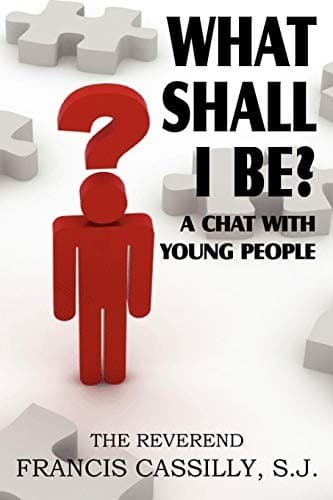
What Shall I Be? A Chat With Young PeopleCassilly, Francis Bernard
Religion
What Shall I Be? A Chat With Young People
Cassilly, Francis Bernard
Catholic Church -- Clergy -- Appointment, call, and election; Vocation, Ecclesiastical
We may now inquire whom Our Lord meant by those "to whom it is given."
Does He mean that the power of practicing virginal chastity is given
only to the selected few or to the many? St. Chrysostom, interpreting
His words, says that this gift of chastity "is given to those who
choose it of their own accord," adding that the "necessary help from
on high is prepared for all who wish to be victors in the struggle
with nature" (M. P. G., t. 58, c. 600). [1] St. Jerome tells us that
this gift "is given to those who ask it, who wish it and labor to
obtain it" (M. P. L., t. 26, c. 135). St. Basil explains that "to
embrace the evangelical mode of life is the privilege of every one."
(M. P. G., t. 32, c. 647.) To the sophistical objection that if all
persons practiced virginity marriage would cease, and so the human
race would perish, St. Thomas (Summa, 2a 2ae, Quaest. 189, art. 7)
gives the reply of St. Jerome, "This virtue is uncommon and desired by
comparatively few"; and then adds, "This fear is just as foolish as
that of one who hesitates to take a drink of water, for fear of drying
up the river."
Can it be said, then, that every boy and girl, with the exception
noted by St. Paul, is advised and exhorted to preserve virginal
chastity throughout life? To understand aright the answer to this
question, we must remember that there are two general courses of life,
the married and the unmarried, open to all; every person necessarily
being found in the one or the other. And each individual of the race
is privileged to make a free and voluntary choice of either condition;
no one having the right to interfere with this personal liberty, by
forbidding or prescribing wedlock to any properly qualified person.
Both these states have been created by God, and both are His gifts to
man. The nuptial tie, elevated to the dignity of a sacrament, is
likened by St. Paul to the union existing between Christ and the
Church. "A prudent wife," says the Book of Proverbs (xix: 14), "is
properly from the Lord." Whoever marries "in the Lord" performs a
virtuous act, and the Church, to show her appreciation and approbation
of it, invests the wedding contract with a rich and hallowed
ceremonial. They, then, who wed do something pleasing to God; but they
who, for virtue's sake, forego their natural right of marrying, make
an offering still more grateful to Him.
Public-domain text, read in full here on John Shaqi.
Reviews
Reviews
No reviews yet
Be the first to share your thoughts on this work.
Join the Discussion
Join the discussion
Sign in to leave a comment or review.
Sign InorCreate an account