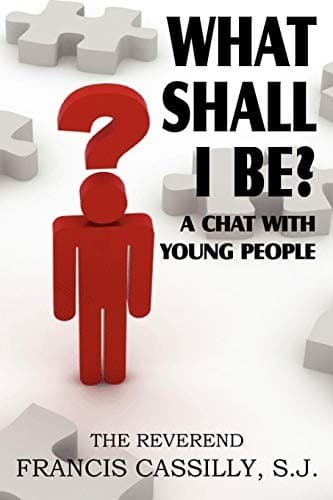
What Shall I Be? A Chat With Young People — John Shaqi
What Shall I Be? A Chat With Young PeopleCassilly, Francis Bernard
Religion
What Shall I Be? A Chat With Young People
Cassilly, Francis Bernard
Catholic Church -- Clergy -- Appointment, call, and election; Vocation, Ecclesiastical
Parents or spiritual directors, who, under the pretext of trying a
vocation, put off for two or three years an aspirant who seems dowered
with all necessary qualities, can scarcely justify themselves in the
eyes of God, such a method being calculated to destroy, not prove, a
vocation. To detain for a few months, however, one who conceives a
sudden notion to enter religion, for the purpose of discovering
whether his intention is serious, and not merely a passing whim, is
only in accordance with the ordinary rules of prudence. In connection
with this point, the words of bluff and hearty St. Jerome, who never
seemed to grow old or lose the buoyancy of youth, are often quoted.
Giving advice to one whom he wished to quit the world, he wrote, "Wait
not even to untie the rope that holds your boat at anchor--cut it."
(M. P. L., t. 26, c. 549.) And Christ's reply to the young man, whom
He had invited to follow Him, and who asked leave to go first and bury
his father, was equally terse: "Let the dead bury their own dead."
(Luke ix: 60.)
In a booklet entitled "Questions on Vocations," published in 1913, by
a Priest of the Congregation of the Mission, the question is asked,
"Do not a larger percentage persevere when subjects enter the
religious state late in life?" And the answer is given: "No; the
records of five of the largest communities of Sisters in the United
States show that a much larger percentage of subjects persevere among
those who enter between the ages of sixteen and twenty, than among
those who enter when they are older. When persons are twenty years of
age, or older, their characters are more set; their minds are less
pliable; it is harder to unbend and remould them. The young are more
readily formed to religious discipline."
In concluding this chapter on the appropriate age for entrance into
religious life, it may be said that, after reaching the prescribed age
of fifteen, the sooner an otherwise properly qualified person enters
the nearer he seems to approach the ideals and traditionary practice
of the Church, and the better he will provide for his own spiritual
welfare.
[1] It would seem that for the space of two centuries, this freedom of
choice was not offered them.
CHAPTER XI
THE PRIESTHOOD
The High Priest of the New Law, St. Paul tells the Hebrews, is Christ.
And the Christian priesthood, which He instituted, is a participation
and extension of His office and ministry. The commemoration of the
same sacrifice which was once offered upon the cross for the sins of
the world is daily renewed on our altars from the rising to the
setting of the sun. The Christian priest, in the language of spiritual
writers, is "another Christ," taking His place amongst men,
perpetually renewing, as it were, the Incarnation in the Sacrifice of
the Mass, preaching the word, and applying the fruits of Redemption
through the channels of the sacraments.
Public-domain text, read in full here on John Shaqi.
Reviews
Reviews
No reviews yet
Be the first to share your thoughts on this work.
Join the Discussion
Join the discussion
Sign in to leave a comment or review.
Sign InorCreate an account