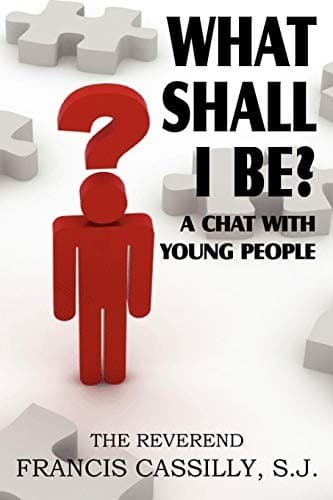
What Shall I Be? A Chat With Young PeopleCassilly, Francis Bernard
Religion
What Shall I Be? A Chat With Young People
Cassilly, Francis Bernard
Catholic Church -- Clergy -- Appointment, call, and election; Vocation, Ecclesiastical
How much better it were for parents to propose to the young the
promise of Our Lord, "And every one that hath left house, or brothers
or sisters or father or mother or wife or children or lands for my
name, shall receive a hundredfold, and possess life everlasting."
(Matt. xix: 29.) Many a one, whose wayward child has brought dishonor
and shame to the family, realizes when all too late the happiness that
might have been his had such a child only elected the religious state.
Instead of throwing obstacles in the way of a vocation, those who are
appreciative of spiritual things feel honored that God has chosen one
of their family circle for His special service. Persons whose sons
obtain high position in the army, court or government employ, take a
just pride in the distinction thus attained, but such temporal honors
cannot be compared with the singular privilege of serving in God's own
courts, and dwelling within His sanctuary. Bishop Schrembs, of Toledo,
aptly advises pastors "to teach young parents that the service of God
is even more glorious than that of country, for as St. Jerome says,
'Such a service establishes ties of relationship between the family
and Jesus Christ Himself.'"
Nor do parents, as they sometimes fear, lose a son or daughter who
enters religion. One who marries is in a certain sense lost to the
parent, for the responsibilities of his new state of life so absorb
his energies as to leave him but little opportunity to concern himself
about his old home. And frequently distance entirely severs his
connection with it. But one who enters God's house does not contract
new family alliances, his heart remains free, and though separated
from parents, his affection is always true to them, he thinks of them
as in his childhood days, and he never ceases to importune the
blessings of heaven upon them.
In fact, we may say that a vocation is not strictly an individual, but
rather a family possession. A call to God implies sacrifice on the
part of the family, as well as of the individual, for while he gives
up parents, brothers and sisters, they, too, must part with him. And
as they share in the renunciation, they participate also in its merit
and reward. In God's household the religious represents his family, he
works and prays by proxy for them, and they share in his graces and
good deeds. Is it not a matter of daily experience that the family of
a religious, particularly the parents, receive abundant graces, that
God leads them in various ways to greater fidelity in His service, to
a love of prayer and higher perfection? Parents of religious
frequently become religious themselves at heart, and though not
clothed with the habit, they share in the "hundredfold" promised to
the child.
Public-domain text, read in full here on John Shaqi.
Reviews
Reviews
No reviews yet
Be the first to share your thoughts on this work.
Join the Discussion
Join the discussion
Sign in to leave a comment or review.
Sign InorCreate an account