What the Negro Has Done for Liberty in AmericaMoore, John, Prof.
History
What the Negro Has Done for Liberty in America
Moore, John, Prof.
African American soldiers; United States -- History -- Civil War, 1861-1865 -- Participation, African American
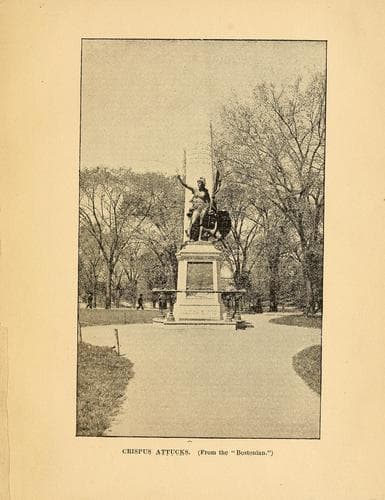
In 1770 an important event took place in Boston. There was a massacre
on King Street now called State. Several men were shot by British
soldiers. The most conspicuous figure there was Crispus Attucks,
a Negro, who lost his life. Years before he had been a slave in
Framingham and escaped from his master. Several advertisements were
published in the _Boston Gazette_, with ample rewards for his capture;
but he was not seized. Twenty years after he came to Boston. When
the British soldiers were insulting and oppressing the true American
patriots, Attucks appeared as the leader to the first resistance to
their tyranny. On March 5th, 1770, Attucks as the leader shouted: “The
way to get rid of these soldiers is to attack the main guard; strike
at the root, there is the nest.” When the British soldiers fired,
Attucks was the first to fall. The body of this hero with that of
another who fell, lay in Fanueil Hall, while others were buried from
their homes. The funeral was said to have been the largest ever known
in this country. Daniel Webster said: “From that moment we may date the
severance of the British Empire.”
At the battle of Bunker Hill, Major Pitcairn was killed, which proved
to be a serious loss to the British. It was he who was the chief
commander of the forces that went out to Lexington and Concord at the
time of the famous fight there. He fell at the hands of private Peter
Salem of Colonel Nixon’s regiment of the Continental Army. This Negro
soldier’s claim to this honor could not be disputed. There was another
Negro soldier who distinguished himself, Salem Poor, and displayed such
valor that fourteen American officers called the attention of Congress
to his merits. The memorial was dated at Cambridge, December 5, 1775,
and stated “that under our own observation, we declare that a Negro man
called Salem Poor, of Colonel Frye’s regiment, Captain Ames’ company,
in the late battle at Charlestown behaved like an experienced officer
as well as an excellent soldier. To set forth the particulars of his
conduct would be tedious. We would only beg leave to say, in the person
of this said Negro, centres a brave and gallant soldier. The reward due
to so great and distinguished a character we submit to the Congress.”
The army organized at Cambridge under General Washington, had from
the start colored men in it. The historian Bancroft states that free
Negroes stood in the ranks by the side of white men. All through the
Revolution the colored man performed a very important part, for which
very little credit has ever been given him.
Public-domain text, read in full here on John Shaqi.
Reviews
Reviews
No reviews yet
Be the first to share your thoughts on this work.
Join the Discussion
Join the discussion
Sign in to leave a comment or review.
Sign InorCreate an account