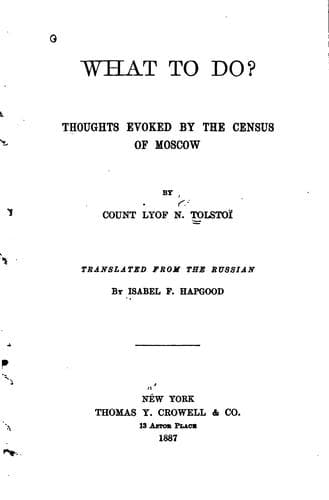
What to Do? Thoughts Evoked by the Census of MoscowTolstoy, Leo, graf
Philosophy
What to Do? Thoughts Evoked by the Census of Moscow
Tolstoy, Leo, graf
Moscow (Russia) -- Social conditions; Social problems
This was the case in question: I have already mentioned the two peasants
with whom I was in the habit of sawing wood three yeans ago. One
Saturday evening at dusk, I was returning to the city in their company.
They were going to their employer to receive their wages. As we were
crossing the Dragomilovsky bridge, we met an old man. He asked alms, and
I gave him twenty kopeks. I gave, and reflected on the good effect which
my charity would have on Semyon, with whom I had been conversing on
religious topics. Semyon, the Vladimir peasant, who had a wife and two
children in Moscow, halted also, pulled round the skirt of his kaftan,
and got out his purse, and from this slender purse he extracted, after
some fumbling, three kopeks, handed it to the old man, and asked for two
kopeks in change. The old man exhibited in his hand two three-kopek
pieces and one kopek. Semyon looked at them, was about to take the
kopek, but thought better of it, pulled off his hat, crossed himself, and
walked on, leaving the old man the three-kopek piece.
I was fully acquainted with Semyon's financial condition. He had no
property at home at all. The money which he had laid by on the day when
he gave three kopeks amounted to six rubles and fifty kopeks.
Accordingly, six rubles and twenty kopeks was the sum of his savings. My
reserve fund was in the neighborhood of six hundred thousand. I had a
wife and children, Semyon had a wife and children. He was younger than
I, and his children were fewer in number than mine; but his children were
small, and two of mine were of an age to work, so that our position, with
the exception of the savings, was on an equality; mine was somewhat the
more favorable, if any thing. He gave three kopeks, I gave twenty. What
did he really give, and what did I really give? What ought I to have
given, in order to do what Semyon had done? he had six hundred kopeks;
out of this he gave one, and afterwards two. I had six hundred thousand
rubles. In order to give what Semyon had given, I should have been
obliged to give three thousand rubles, and ask for two thousand in
change, and then leave the two thousand with the old man, cross myself,
and go my way, calmly conversing about life in the factories, and the
cost of liver in the Smolensk market.
I thought of this at the time; but it was only long afterwards that I was
in a condition to draw from this incident that deduction which inevitably
results from it. This deduction is so uncommon and so singular,
apparently, that, in spite of its mathematical infallibility, one
requires time to grow used to it. It does seem as though there must be
some mistake, but mistake there is none. There is merely the fearful
mist of error in which we live.
[This deduction, when I arrived at it, and when I recognized its
undoubted truth, furnished me with an explanation of my shame in the
presence of the cook's wife, and of all the poor people to whom I had
given and to whom I still give money.
Public-domain text, read in full here on John Shaqi.
Reviews
Reviews
No reviews yet
Be the first to share your thoughts on this work.
Elsewhere in the archive
Join the Discussion
Join the discussion
Sign in to leave a comment or review.
Sign InorCreate an account