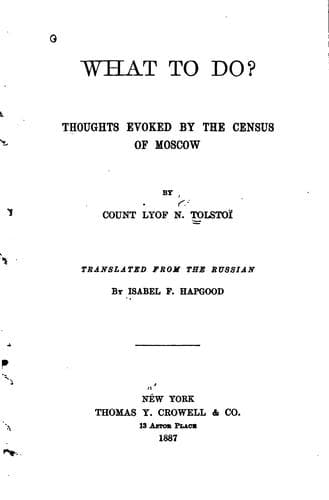
What to Do? Thoughts Evoked by the Census of MoscowTolstoy, Leo, graf
Philosophy
What to Do? Thoughts Evoked by the Census of Moscow
Tolstoy, Leo, graf
Moscow (Russia) -- Social conditions; Social problems
What, in point of fact, is that money which I give to the poor, and which
the cook's wife thought I was giving to her? In the majority of cases,
it is that portion of my substance which it is impossible even to express
in figures to Semyon and the cook's wife,--it is generally one millionth
part or about that. I give so little that the bestowal of any money is
not and cannot be a deprivation to me; it is only a pleasure in which I
amuse myself when the whim seizes me. And it was thus that the cook's
wife understood it. If I give to a man who steps in from the street one
ruble or twenty kopeks, why should not I give her a ruble also? In the
opinion of the cook's wife, such a bestowal of money is precisely the
same as the flinging of honey-cakes to the people by gentlemen; it
furnishes the people who have a great deal of superfluous cash with
amusement. I was mortified because the mistake made by the cook's wife
demonstrated to me distinctly the view which she, and all people who are
not rich, must take of me: "He is flinging away his folly, i.e., his
unearned money."
As a matter of fact, what is my money, and whence did it come into my
possession? A portion of it I accumulated from the land which I received
from my father. A peasant sold his last sheep or cow in order to give
the money to me. Another portion of my money is the money which I have
received for my writings, for my books. If my books are hurtful, I only
lead astray those who purchase them, and the money which I receive for
them is ill-earned money; but if my books are useful to people, then the
issue is still more disastrous. I do not give them to people: I say,
"Give me seventeen rubles, and I will give them to you." And as the
peasant sells his last sheep, in this case the poor student or teacher,
or any other poor man, deprives himself of necessaries in order to give
me this money. And so I have accumulated a great deal of money in that
way, and what do I do with it? I take that money to the city, and bestow
it on the poor, only when they fulfil my caprices, and come hither to the
city to clean my sidewalk, lamps, and shoes; to work for me in factories.
And in return for this money, I force from them every thing that I can;
that is to say, I try to give them as little as possible, and to receive
as much as possible from them. And all at once I begin, quite
unexpectedly, to bestow this money as a simple gift, on these same poor
persons, not on all, but on those to whom I take a fancy. Why should not
every poor person expect that it is quite possible that the luck may fall
to him of being one of those with whom I shall amuse myself by
distributing my superfluous money? And so all look upon me as the cook's
wife did.
And I had gone so far astray that this taking of thousands from the poor
with one hand, and this flinging of kopeks with the other, to those to
whom the whim moved me to give, I called good. No wonder that I felt
ashamed.] {116}
Public-domain text, read in full here on John Shaqi.
Reviews
Reviews
No reviews yet
Be the first to share your thoughts on this work.
Elsewhere in the archive
Join the Discussion
Join the discussion
Sign in to leave a comment or review.
Sign InorCreate an account