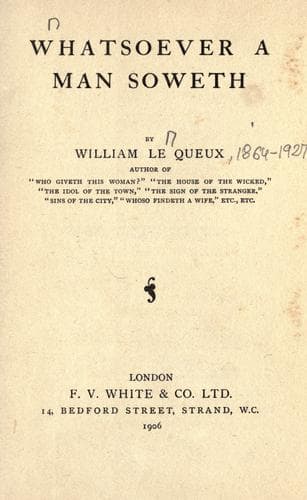
London (England) -- Fiction; Man-woman relationships -- Fiction; Mystery fiction
My visit to Ryhall was to end on the morrow, and she had promised to
drive me up to town on her car.
The men of the party had not yet returned from shooting, and in that
calm sunset hour we were alone in the fine old gallery, with its
splendid tapestries, its old carved coffers and straight-backed chairs,
its rows of antlers and its armour of the dead-and-gone Scarcliffs.
High in the long windows were the rose en soleil of Edward IV, the crown
in the hawthorn bush of Henry VII, the wolf's head crowned, the badge of
the Scarcliffs, and other armorial devices, while the autumn sunlight
slanting in threw coloured reflections upon the oaken floor worn smooth
and polished by the feet of generations.
She was dressed in cream serge, a slight, dainty, neat-waisted figure,
thrown into relief as she leaned back against the dark old panelling,
laughing at my retort.
Her musical voice echoed down the long corridor, that old place that
always seemed so far remote from the present day, and where the country
folk declared that at night could be heard the footfall of the knight
and the rustle of the lady's kirtle.
Ryhall was indeed a magnificent old place, built by Sir Henry Burnet in
the Tudor days, and pre-eminent to-day among the historic mansions of
England, an architectural triumph that still remained almost the same as
it was on the death of its builder. Its great vaulted hall with the
wonderful fireplace and carved minstrels' gallery, its fine old
tapestries in King James's room, the yellow drawing-room, the red
boudoir, and the Baron's hall, full of antique furniture, were all
splendid apartments breathing of an age long past and forgotten.
Being something of an antiquary myself, I loved Ryhall, and took a keen
delight in exploring its quaint passages and discovering its secret
doors in picture-frames and panelling. Tibbie, however, who had no love
for old things, hated Ryhall. She preferred everything essentially
modern, the art nouveau, art colourings, and the electric light of her
mother's house in Grosvenor Street. She only came down to Ryhall when
absolutely necessary, and then grumbled constantly, even worrying Jack,
her brother--now Lord Scarcliff--to "put some decent new furniture into
the place," and declaring to her mother that the house was full of moths
and rats.
"Look!" she suddenly exclaimed at last. "The boys are coming home!
Can't you see them there, down in the avenue?" and she pointed with her
finger. "Well," she added, "you're not a bit entertaining, Wilfrid.
You refuse to become my husband, so I suppose I shall have to marry
someone else. The mater says I really must marry somebody."
"Of course, you must," I said. "But who is to be the happy man? Have
you decided?"
"M'-well, I don't quite know. Ellice Winsloe is a good fellow, and
we're very friendly," she admitted. "The mater approves of him, because
he's well off."
"Then she wouldn't approve of me," I laughed. "You know I haven't got
very much."
Public-domain text, read in full here on John Shaqi.
Reviews
Reviews
No reviews yet
Be the first to share your thoughts on this work.
Join the Discussion
Join the discussion
Sign in to leave a comment or review.
Sign InorCreate an account