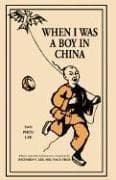
China -- Social life and customs -- 1644-1912; Lee, Yan Phou, 1861-1938?
Supper came at six when we had rice, meats and vegetables. Our faces
invariably were washed after supper in warm water. This is customary.
Then the lamps were lighted; and when the teachers came down, full
forty pairs of lungs were at work with lessons of next day. At eight
o’clock, one of the teachers read and explained a long extract from
Chinese history, which, let me assure you, is replete with interest. At
nine o’clock we were sent to our beds. Nothing ever happened of special
interest. I remember that we used to talk till pretty late, and that
some of the nights that I spent there were not of the pleasantest kind
because I was haunted by the fear of spirits.
After breakfast the following morning we assembled in the same
schoolroom to study our English lessons. The teacher of this branch
was a Chinese gentleman who learned his English at Hongkong. The first
thing to be done with me was to teach me the alphabet. When the teacher
grew tired he set some advanced pupils to teach me. The letters sounded
rather funny, I must say. It took me two days to learn them. The letter
_R_ was the hardest one to pronounce, but I soon learned to give
it, with a peculiar roll of the tongue even. We were taught to read and
write English and managed by means of primers and phrase-books to pick
up a limited knowledge of the language. A year thus passed in study and
pastime. Sundays were given to us to spend as holidays.
It was in the month of May when we were examined in our English studies
and the best thirty were selected to go to America, their proficiency
in Chinese, their general deportment and their record also being taken
into account.
There was great rejoicing among our friends and kindred. For the
cadet’s gilt button and rank were conferred on us, which, like the
first literary degree, was a step towards fortune, rank and influence.
Large posters were posted up at the front doors of our homes, informing
the world in gold characters of the great honor which had come to the
family.
We paid visits of ceremony to the _Tautai_, chief officer of the
department, and to the American consul-general, dressed in our official
robes and carried in fine carriages. By the first part of June, we
were ready for the ocean journey. We bade our friends farewell with due
solemnity, for the thought that on our return after fifteen years of
study abroad half of them might be dead, made us rather serious. But
the sadness of parting was soon over and homesickness and dreariness
took its place, as the steamer steamed out of the river and our native
country grew indistinct in the twilight.
CHAPTER XII.
FIRST EXPERIENCES IN AMERICA.
After a stormy voyage of one week, with the usual accompaniment of
seasickness, we landed at Yokohama, in the Country of the Rising Sun.
For Japan means “sun-origin.” The Japanese claim to be descendants of
the sun, instead of being an off-shoot of the Chinese race.
Public-domain text, read in full here on John Shaqi.
Reviews
Reviews
No reviews yet
Be the first to share your thoughts on this work.
Join the Discussion
Join the discussion
Sign in to leave a comment or review.
Sign InorCreate an account