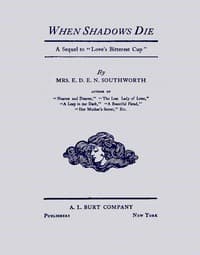
When shadows dieSouthworth, Emma Dorothy Eliza Nevitte
General
When shadows die
Southworth, Emma Dorothy Eliza Nevitte
American fiction -- 19th century
“‘No; I would not. I should have my child to occupy and interest me; and
I shall have the poor on the estate to look after.’
“‘These duties could not fill your heart, Elfrida. You would languish
into melancholia or death. Listen, Elfrida—dearest Elfrida! You talked
of that wild seacoast manor house as a haven of rest. It would not be
so. It would be to you as a desert, a prison, an exile. See, Elfrida!
Here is your true haven of rest!’ he said, bending toward me with a look
that sent all the blood rushing to my head and face.
“‘What do you mean? Where?’ I cried, in alarm, though I did not
understand his meaning.
“‘Here!’ he exclaimed, striking his breast and then extending both hands
toward me—‘Here! in my love!—in my arms!—in my bosom! Oh, Elfrida!
accept the life’s devotion of one who adores you, and who will gladly
consecrate all his days to your happiness!’
“I could no longer misunderstand him; nor could I speak for amazement
and indignation. He took advantage of my silence to pour out the
malebolge of his revolting passion before me.
“At last, with a great effort, I conquered the speechless panic into
which his insults had thrown me, and my wrath and shame burst forth in
strong and fiery words.
“I ordered him from my presence; but he did not go. I called him hard
names—a snake in the grass—a wolf in sheep’s clothing, a traitor, a
hypocrite.
“He did not reply; he stood up before me and took it all, devouring me
with his eyes, while his tongue was silent.
“At length, my paroxysm of violence broke down in tears, and I wept in
bitter anguish.
“‘Although I am forsaken, yet still I am a wife!’ I said; ‘though my
husband has left me, yet still he is my husband.’
“These words gave him the opportunity he now wanted.
“I had sunk down in my chair and covered my face with my hands.
“He came up to me, laid his hand on the back of my chair, and dropping
his voice to the lowest tones of reverential sympathy, he said these
terrible words:
“‘No, Elfrida! No, my poor child! It breaks my heart to tell you the
truth, that I have only recently learned to my dismay; but you must hear
it sooner or later. Better to hear it kindly, tenderly told by a
friend’s tongue than harshly and suddenly by a wordling’s or an enemy’s.
No, Elfrida! You are no wife.’
“‘Saviola is dead, then!’ I exclaimed, in an access of excitement.
“‘No, Elfrida; that is not what I mean. You are no wife, because—you
never have been.’
“I lifted my head and gazed on him in dumb horror and amazement.
“He met my look with one of deepest sorrow and commiseration.
“‘It is false!’ I cried, as soon as I could speak. ‘It is foully,
cruelly false!’
“‘I would to Heaven it were!’ he sighed. ‘I would to Heaven it were!’
Public-domain text, read in full here on John Shaqi.
Reviews
Reviews
No reviews yet
Be the first to share your thoughts on this work.
Elsewhere in the archive
Join the Discussion
Join the discussion
Sign in to leave a comment or review.
Sign InorCreate an account