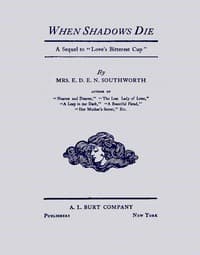
When shadows dieSouthworth, Emma Dorothy Eliza Nevitte
General
When shadows die
Southworth, Emma Dorothy Eliza Nevitte
American fiction -- 19th century
He no longer required the arm of his valet to lean on, or even the help
of a cane to walk with.
One day his sister said to him:
“Francis, I do believe that you have been more of a hypochondriac than
of a real invalid, after all.”
“Elf,” he answered, “I am inclined to suspect that you are right.
Certainly most of my ailments, real or imaginary, have vanished under
the influence of change, motion and society.”
As the earl continued to improve in health and strength, his sister
watched him with a new interest.
On another day she said to him:
“Francis, why don’t you marry?”
Lord Enderby started, and then he laughed.
“What has put that into your head?” he inquired.
“My anxious interest in your future—now that you have a future,
brother.”
“Would you, who are my heir presumptive, wish me to marry?”
“Indeed, I would! You would be so much better and happier! Think of it,
Francis!”
“My dearest, I am both too old and too young to fall in love!” laughed
the earl.
“What rubbish! ‘Too old and too young!’ What do you mean by such
absurdity?”
“I have passed my first youth of sentiment, and I have not yet reached
my second childhood of senility! Therefore, I am both too old and too
young to fall in love.”
“Nonsense! That is not true; and, even if it were, you are neither too
young nor too old to marry. It is not necessary that you should ‘fall in
love.’ You might meet some lady, however, whom you could love, and
esteem, and marry.”
“Where should I be likely to find such a lady? My dear, I have never
gone into society at all. Since my return from India I have led a
secluded life, on account of my health.”
“On account of your hypochondria, you mean! Now, Francis, you must
change all that. In the beginning of the next London season you must
open your house on Westbourne Terrace, and entertain company.”
“Will you do the honors, Elfrida?”
“Of course I will,” replied the lady.
“And you can bring out your two daughters, and present them at court.”
“Yes, I might do that.”
“Very well.”
Had the earl felt disposed to look about him for a wife, he might have
found a suitable one in Baden-Baden.
There were many of the English nobility and gentry staying there for the
benefit of the baths. Many very attractive young ladies of rank were in
the matrimonial market. But, to tell the truth, the invalid earl, either
from real ill health or from hypochondria, was very shy of strangers,
and better liked to stroll, or ride, or drive with “the children,” as he
called his nieces and their young friend, than to linger in the parlors
of the hotel or the pavilions of the place.
In their rambles Odalite seldom joined them. She preferred to stay with
her suffering father, and share the labors of her mother in the sick
room. The earl and the three younger girls usually set out together.
Wynnette and Elva walking on before; the earl, with little Rosemary’s
hand clasped in his own, followed behind.
Public-domain text, read in full here on John Shaqi.
Reviews
Reviews
No reviews yet
Be the first to share your thoughts on this work.
Join the Discussion
Join the discussion
Sign in to leave a comment or review.
Sign InorCreate an account