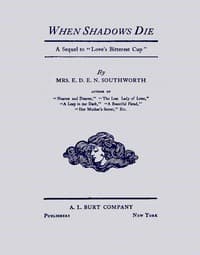
When shadows dieSouthworth, Emma Dorothy Eliza Nevitte
General
When shadows die
Southworth, Emma Dorothy Eliza Nevitte
American fiction -- 19th century
“On the next day I went down to the sitting room we three occupied in
common. I certainly did not expect to find you there, Abel Force; yet
there you were, looking a little graver than usual, but otherwise
behaving as if nothing unusual had been said or done. You bade me
good-morning, handed me a chair, and inquired after my health.
“Well, though to my surprise I found you in our sitting room that
morning, I certainly expected you to leave our party on the first
opportunity. But you did not. You remained with us and traveled with us
as before.
“I shrank from speaking to my father on the subject, yet at length I
summoned courage to ask him if he had given my answer to you. He replied
that he had, and that you had said you could wait and hope.
“We spent the autumn together, as we had spent the summer; yet, Abel, we
were not happy, and as the time for our return to England and your
return to America approached, and we were to separate to meet no more in
this world, we both grew more and more miserable. As for me, my heart
seemed wasting to death.
“One day in November my father came to me, and said:
“‘Elfrida, do you consider me a man of honor, or not?’
“‘My dear father, what a question!’ was all that I could answer.
“‘But tell me, do you consider me a man of honor? Yes, or no!’
“‘Yes, my dear father; yes. A man of the most perfect and most
unquestionable honor,’ I replied.
“‘Good! Then perhaps you will believe me and act upon my words. Elfrida,
Mr. Force has this morning begged me to speak for him again. Again he
offers you his hand.’
“‘Well, my dear father?’
“‘Well, Elfrida, he loves you, and you know it. You love him, and he
knows it. You are both dying for each other, and I know that.’
“‘Well, my dear father?’ I said again.
“‘Have pity on him and on yourself, and accept his suit.’
“‘But, my past—my past—which I can never tell him—never! I could die
first.’
“‘Elfrida, do you believe your father to be a man of honor?’ he
inquired, for the third time.
“‘Dear sir, how can you ask me? I have said, “a man of indubitable
honor,”’ I replied.
“‘Very well, then. On the truth of a man, on the honor of a peer, on the
faith of a Christian, I swear to you, Elfrida, that you may marry Force
without telling him one word of your past trouble,’ he said to me, so
solemnly that I could not question him. I could only receive his words
on the high and sacred ground on which he had spoken them.
“Oh, Abel! was I wrong?
“‘I am now going to send Force to see you,’ he repeated, as he left the
room.
Public-domain text, read in full here on John Shaqi.
Reviews
Reviews
No reviews yet
Be the first to share your thoughts on this work.
Elsewhere in the archive
Join the Discussion
Join the discussion
Sign in to leave a comment or review.
Sign InorCreate an account