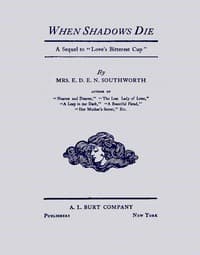
When shadows dieSouthworth, Emma Dorothy Eliza Nevitte
General
When shadows die
Southworth, Emma Dorothy Eliza Nevitte
American fiction -- 19th century
“Heaven knows that I wish to do so, my dear lad! Perhaps you may answer
me one more question—a last one: Why did you drop your lawful name of
‘Roland Bayard,’ and take another by which you are now known—‘Craven
Cloud?’ You need not answer if you do not choose?”
“I will tell you. The life of a blockade runner——”
“Blockade runner be blowed!” angrily exclaimed the old skipper. “Pirate,
you mean! You can’t blind me with—blockade runner! Not after her taking
the _Kitty_, you can’t! Pirate, lad—pirate!”
“Just as you please! The life, I say, on such a ship is uncertain; death
often tragic. I did not wish to carry an honest name through such a
life, or to such a death. In a word—if those who loved me were destined
to hear one Craven Cloud—blockade runner, pirate, slaver, as you
please—had been taken and hanged, I did not wish them to know that I was
the man. I took an alias, and I made it Craven Cloud because the name
suited the case. There! that is all.”
“But, Roland, you are no pirate—no slaver. It is impossible that you
should be!” exclaimed the old skipper with the utmost confidence, yet
still eagerly, prayerfully gazing into the troubled face of his young
mate for confirmation of those words.
But still no such confirmation came.
The door opened and a soldier entered.
“Sorry,” he said, in a serio-comic spirit in which some of the soldiers
jested their cares away, “sorry to separate you, but the best of friends
must part. Shutting up time has come, and the word is march!”
“Do you mean I must go?” inquired the old skipper.
“That’s about the measure of it, granddad.”
“Good-by, Roland, lad! Mind, I don’t believe any ill of you, in spite of
all. I shall come to see you again to-morrow, and bring Rosemary with
me.”
“No! no! no! no! Do not bring her! I am parted from Rosemary forever!
The sight of her—would unman me!” cried the youth.
“Then—what am I to say to her when I see her?”
“Say—the best you can—the fairest, the most merciful you can!” exclaimed
Roland.
The old skipper wrung the youth’s hand and left the room.
He returned to the hotel, but kept entirely out of the way of the
Forces. He had not the courage to meet Rosemary.
CHAPTER XVII
ON BOARD THE PRIZE
Soon after dinner the earl and the squire left the hotel for the ship.
They took a street car that ran from Georgetown to the navy yard gate.
There they alighted and entered the yard, passed the officers’ quarters,
passed the workshops and the ship house and went down to the water side.
As they neared it they saw an officer in naval uniform standing with his
back toward them, and his gaze directed toward a boat, rowed by six men,
that was swiftly coming toward the shore.
Mr. Force quickened his steps and laid his hand on the arm of the man,
whom he had recognized as Le.
The latter turned quickly, started joyfully, and held out both hands,
exclaiming:
“Uncle Abel!”
Public-domain text, read in full here on John Shaqi.
Reviews
Reviews
No reviews yet
Be the first to share your thoughts on this work.
Join the Discussion
Join the discussion
Sign in to leave a comment or review.
Sign InorCreate an account