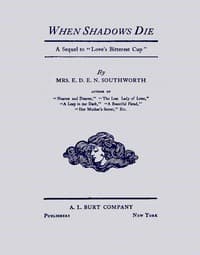
When shadows dieSouthworth, Emma Dorothy Eliza Nevitte
General
When shadows die
Southworth, Emma Dorothy Eliza Nevitte
American fiction -- 19th century
“But, Le—this is awfully sudden!” exclaimed Mr. Force, as he wrung the
young midshipman’s hand.
“Yes! yes! awfully sudden! Odalite! Oh, Odalite!” he cried, turning to
his eldest cousin and once betrothed last of all, as if he had reserved
his very last embrace and kiss for his best beloved—“oh, my Odalite! May
God love, and bless, and guard you. Good-by! Good-by! my dearest dear!”
And Le pressed her to his heart, and turned and dashed out of the room.
“But, Le! But, Le! Wait! Can we not go to the ship and see you off?”
cried Wynnette, hurrying after him, and overtaking him at the street
door.
“No! no! Impossible, my dear! A boat is waiting to take me to the ship!
I have barely time to reach her deck before she sails! There would be no
time for last adieus there! God bless you! Take care of Odalite!”
The street door banged behind Le, and he was gone.
Wynnette had flown downstairs, but she crawled up again, dragging weary
steps, “woe befreighted,” behind her.
She entered the room, and sat down in silent sympathy beside Odalite,
who lay back in her chair, too stunned by the shock of all that had
happened to weep or to moan, or even to realize the situation.
Mrs. Force went and sat on the other side of her stricken daughter, took
her hand, and said:
“My dear, nothing but prayer can help you now. You must pray, Odalite.”
The girl pressed her mother’s hand, but made no reply.
Mr. Force and Lord Enderby were in close conversation on the political
conflict out of which the war had arisen.
Elva and Rosemary were standing together in the oriel window overlooking
the street, too much startled by the suddenness of events to feel like
talking.
“Let us hope that this trouble will soon be over,” said the earl.
“What! be put down like one of your corn riots, by the simple reading of
the ‘act’?” inquired Abel Force, grimly. “No, Enderby! I know my
countrymen, North and South. And the civilized world will see a war that
has never been paralleled in the history of nations.”
And his words proved prophetic.
After this day every mail from America was looked for in the keenest
anxiety; and every mail brought the most startling and exciting news.
Every schoolboy and schoolgirl is now familiar with the leading events
of the war, and they need not be rehearsed here.
Among news of more general interest came some of a private nature to the
Forces.
Among the rest, letters from Mrs. Anglesea, who wrote:
“You had better pack right up and come right home. ‘The devil is to
pay, and no pitch hot!’ The people have riz up ag’in’ one another like
mad. Ned Grandiere has gone into the Confederate Army. Sam sticks at
home. He says war is bad for the crops, and somebody must plow and
sow.
“William Elk has gone into the Union Army.
Public-domain text, read in full here on John Shaqi.
Reviews
Reviews
No reviews yet
Be the first to share your thoughts on this work.
Join the Discussion
Join the discussion
Sign in to leave a comment or review.
Sign InorCreate an account