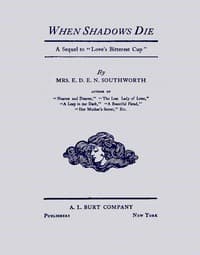
When shadows dieSouthworth, Emma Dorothy Eliza Nevitte
General
When shadows die
Southworth, Emma Dorothy Eliza Nevitte
American fiction -- 19th century
“But again my heart leaped to meet father and brother, and I loved and
adored them. I asked why my stepmother had not come with them. My father
told me that she was much too frail to bear the sea air even in summer.
“He was satisfied with my health, and with my progress in learning, and
so he left us, taking the boy with him.
“I had now been more than four years at dreary Weirdwaste, and had not
known any home but the old manor house, or any society than its inmates.
As these first four years passed so passed the next seven.
“My father came about once a year to see me, bringing my brother with
him. He always spent a week at Weirdwaste, and then returned to England,
taking my brother with him.
“His time was entirely devoted to his invalid wife, whose life seemed
only to be prolonged by his incessant care.
“They were always moving from place to place, as the seasons changed—in
Switzerland, or in Norway, or Sweden in the summer; in the south of
France, in Italy, or among the isles of the Grecian Archipelago in
winter. Sometimes in the finest weather of the early summer they came to
London, during which time the countess would visit her mother, and then
my father would take my little brother and come on a flying visit to me.
“So the years went on until I reached my fifteenth year, when the days
of my dark destiny drew near.”
CHAPTER XXVI
BRIGHTON YEARS AGO
“You may never have occasion to read these lines, yet I come to my task
from time to time to prepare them for you.
“Let me resume:
“I never was reconciled to my lonely life at Weirdwaste, but as the
years passed on, and I grew toward womanhood the solitude and monotony
of my surroundings pressed more and more heavily upon my health and
spirits.
“My father in these years seemed almost to have forgotten me. He was
with my mother on one of the islands of the Grecian Archipelago—for her
health. My little brother—now a well-grown schoolboy—was at Rugby. You
see, our family of four was scattered.
“About this time my health and spirits became so seriously affected that
Dr. Alexander thought it necessary to call my father’s attention to the
fact. He wrote to him, and in due time received an answer.
“It was something to this effect:
“‘As you recommend the south coast, you will please take the girl to
Brighton, and take suitable lodgings for herself and her attendants.
As she is no longer a child she must have more advanced teachers. Miss
Murray may be retained as her companion or chaperon, but a French
governess must be engaged for her.
“‘I leave all this to you. Our good vicar will be able to assist you.
“‘My son will join his sister at the seaside for the midsummer
holidays. Draw on me for the necessary funds.’
“The prospect of any change filled my soul with delightful
anticipations.
Public-domain text, read in full here on John Shaqi.
Reviews
Reviews
No reviews yet
Be the first to share your thoughts on this work.
Elsewhere in the archive
Join the Discussion
Join the discussion
Sign in to leave a comment or review.
Sign InorCreate an account