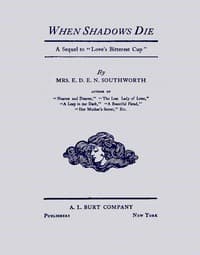
When shadows dieSouthworth, Emma Dorothy Eliza Nevitte
General
When shadows die
Southworth, Emma Dorothy Eliza Nevitte
American fiction -- 19th century
“It was now the middle of June. By the first of July I was established
in delightful lodgings on the King’s Road, facing the sea.
“We had the whole of the first floor, consisting of a suit of eight
rooms—drawing room, dining room, schoolroom, bathroom and four bedrooms.
“I was delighted with the gay vision of life and motion all around me;
there seemed to be a perpetual gala.
“The splendor of the view from my front windows was not all the splendor
of sea and sky; it was fleets of gayly decked craft, of all sizes and
shapes, from the queenly yacht to the pretty little rowboats; and the
pier, with its bazaars of toys, trinkets and jewelry; the bathing
houses, the frolicsome children in the surf or on the sands, the
brilliant crowds on the esplanade, the bands of music, the magnificent
shops, with displays of sumptuous fabrics and splendid jewels, not to be
surpassed in those of Paris or Constantinople.
“In fact, to me, who had never been in a town before—to me, coming from
lonely and dreary Weirdwaste—Brighton was a dazzling, bewildering scene
of light, life, gayety, splendor and magnificence.
“And if it was all this viewed only from the front windows of my
lodgings, what was it, let me ask you, afterward, when my schoolboy
brother and his friends came, full of high spirits, to make the most of
our opportunities?
“On the second day after our installment at our lodgings we were joined
by the French governess who had been engaged for me.
“She was a small, dark, middle-aged woman, with black hair, and sharp,
black eyes. Her name was De la Champe—Madame de la Champe. Her last
place had been in the service of a duchess, whose last daughter having
just been married, madame found herself under the necessity of seeking a
new engagement, and had found one through the vicar’s answer to her
advertisement.
“I did not like her, though she came so highly recommended. But my
prejudice against the Frenchwoman was not the slightest drawback to my
intense enjoyment of my new and delightful surroundings.
“On the fourth day after our arrival we were joined by my brother and
his friend. My brother was then a bright lad of twelve, looking older
than his years, because he was really a very precocious boy. He greeted
me with the warmest affection, and promised me a ‘jolly old time.’ His
friend was Angus Anglesea, a young man eight years his senior, who,
however, had formed a strong attachment for the bright lad, and taken
him under his protection.
“Angus Anglesea was at this time about twenty years of age; with a form
of medium height, slender and fair, with light hair and mustache, and
blue eyes. His appearance and manners were pleasing and attractive.
“I could not have believed any evil of him then.
Public-domain text, read in full here on John Shaqi.
Reviews
Reviews
No reviews yet
Be the first to share your thoughts on this work.
Elsewhere in the archive
Join the Discussion
Join the discussion
Sign in to leave a comment or review.
Sign InorCreate an account