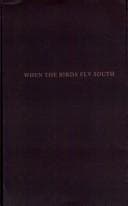
When the birds fly southCoblentz, Stanton A. (Stanton Arthur)
Science
When the birds fly south
Coblentz, Stanton A. (Stanton Arthur)
Afghanistan -- Fiction; Fantasy fiction; Man-woman relationships -- Fiction
"You will be accepting nothing that we need," he insisted. "No matter
how much you require, we will have ample."
And with a nod signifying that the interview was over, Abthar returned
to his work amid the vines.
Hence it came about that, during the following weeks, I was busy
preparing for the winter. Under the warm September skies, flecked with
scarcely a cloud and lying like a serene blue roof between the great
pillars of the peaks, I was providing ceaselessly for the season of
tempests and snow. I equipped my cabin to be snug and relatively
weather-proof; I heaped it with firewood in the shape of the sawed dead
pine-branches which I bore laboriously from the forest; I provisioned
it with lentils, millet, wheat, barley, beans, dried mushrooms, and
"salep" (a paste made from a local tuber), which the people showered
upon me with amazing generosity.
But do not imagine that I found this work distasteful. City-bred
modern though I was, I felt a certain atavistic joy in my return to
the primitive. That joy, I must confess, was all the greater since I
did not always labor alone, for Yasma, like an agile and ingratiating
child, frequently would come running to my assistance. Not only did
she prove a fascinating companion, but she would display remarkable
skill and strength at manual tasks; she would insist on lifting great
chunks of firewood, yet would scarcely appear to feel the strain; she
would pile my provisions in a corner of the cabin with a regularity
and neatness that made me marvel; she would bring me earthenware pots
and pans, jugs and kitchen utensils, and would seem to hear neither my
protestations nor my thanks.
Nevertheless, I was already beginning to observe--and to be puzzled
at--the contradictions in her manner. Although she freely volunteered
to help me, she did not always work wholeheartedly. At times there was
a sadness and constraint about her; and my most determined efforts
could not penetrate behind the veil. Even today I can see her standing
aloof and wistful in the green fields, gazing in a revery toward the
great stone woman on the peak, or merely following with her eyes the
lazily drifting cotton clouds as though she would float with them to
lands beyond the mountains. I do not know why this memory comes back
to haunt and mock me, for then I did not understand, and now that I
understand it is too late; but when I recall how she would remain
staring at the southern summits, it seems to me that her eyes were
like the eyes of fate itself, peering beyond that which is to that
which must be and that which never can be.
Public-domain text, read in full here on John Shaqi.
Reviews
Reviews
No reviews yet
Be the first to share your thoughts on this work.
Join the Discussion
Join the discussion
Sign in to leave a comment or review.
Sign InorCreate an account