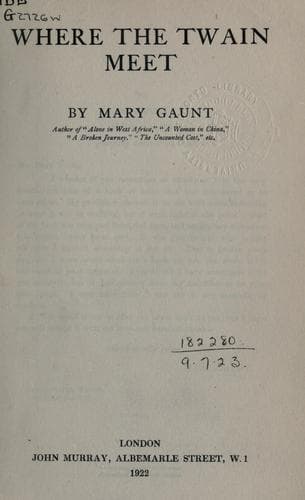
Black people -- Jamaica; Jamaica; Slavery -- Jamaica
General Walpole was bitterly angry. He had given his word, and the
country had broken it, and in his turn he declined to accept the sword
of honour which the Assembly voted him in honour of his bloodless
victory, and declined it in such terms that the Assembly considered the
letter a misrepresentation of their proceedings and ordered it to be
expunged from their minutes.
Not all of the Maroons were banished. Those who came in by the 1st of
January 1796 were allowed to stay if they so pleased, and they settled
about their old town and about Accompong, but their teeth were drawn.
They were no greater danger now than any of the other black people.
Less, in fact, for they had a certain contempt for the slaves, and
regarded themselves as on a par with the white men.
The people about Maroon Town now do not think of themselves as Maroons.
The day I went up, when we had gone as far as we could within a mile and
a half of the old Maroon Town, the people came crowding round, and they
looked much like the dark folks who lived lower down in the mountains.
One yellow man brought me a can full of green coffee berries.
“No, not for sale, for the lady to remember we's by.” I accepted the
gift, so graciously given, and I asked the giver's name.
“Heed,” said he, and I said I'd put him in a book, but I don't believe
he understood what I said. I felt in my pocket. I know of old the
African likes a return present, but I had forgotten my purse, and my
host settled the difficulty.
“Take him round to the Chinaman's shop,” he said to his driver, “and
give him a drink,” and my yellow friend, whom I thought must be grandson
to one of those long-dead soldiers, accepted the offer with a smile.
CHAPTER IX--THE FOOTPRINTS OF THE YEARS
It is very difficult to understand the attitude towards trivial
offences of people who lived in a time when the death penalty was
legally inflicted for breaking down the banks of a fish pond, stealing
anything over the value of a shilling from the person, or illegally
felling trees.
With the last clause I have some sympathy. I sometimes feel I could
cheerfully see the death penalty inflicted upon whoever was responsible
for making Jamaican towns bare of trees, for decreeing that telephone
and telegraph wires are of more importance than shade, and for clearing
all the country roads so that a tropical sun makes them a purgatory for
the unfortunate traveller, when Nature herself has arranged so much more
wisely.
But that is somehow in another dimension, and I quite realise when white
people were so hard on each other as they were a hundred years ago, we
could not expect much consideration from them for the men they held in
bondage.
Public-domain text, read in full here on John Shaqi.
Reviews
Reviews
No reviews yet
Be the first to share your thoughts on this work.
Elsewhere in the archive
Join the Discussion
Join the discussion
Sign in to leave a comment or review.
Sign InorCreate an account