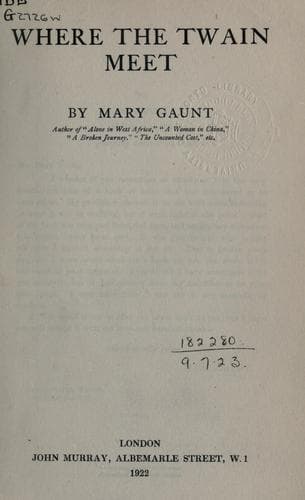
Black people -- Jamaica; Jamaica; Slavery -- Jamaica
The man who comes out to a new land is apt always to see the land he
leaves behind through a softening veil that enhances its desirability.
He sees only its good points. And naturally this emphasises the
drawbacks of the new land. He speaks disparagingly of it, he writes home
disparagingly, dwelling on his many hardships. Jamaica was no exception
to the almost universal rule. Most men went there to make their
fortunes, with every intention of returning to spend them. Only Hans
Sloane, a wise and far-seeing man, saw the glory of the land, and left
behind him a record of its wealth and its beauty and fertility. Lady
Nugent, writing more than one hundred years later, was much more swayed
by public opinion, and saw what she was told she would see, a deadly
climate where men died like flies, though even she does arrive at the
poignant fact that the women who lived with less licence, bore this
climate far better than their mates.
From her pen, too, we first have some pity for the unfortunates the
British imported from the Guinea Coast to work in their plantations.
Terrible are the stories told of the sufferings of this alien people
from the moment they fell into the hands of the slavers till they stood
in the slave markets at Kingston or Montego Bay, told calmly, told
coldly, told simply as facts by men who saw only the difficulties of
the trade, and of dealing with men and women who “wilfully” drowned
themselves to escape their fate. On arrival, the stronger like cattle
were sold in the open market, but only here and there do we get awful
glimpses of the fate that befell the weaker.
Life was no bed of roses for the planter and his white assistants,
working to provide funds to be spent in the old country, but it was
simply a hell at first for the savages they worked.
On the plantations no white woman was welcome. As the masters had taken
the white bondswoman for their temporary companions, so now they took
the black while they were young and comely. At first it was savages
and white masters, and the little coloured children who were but their
fathers' chattels.
So slowly the people progressed, we hardly realise there was any
progress, till we see the men and women of dark complexion clothed and
ardent church members, even though they are slaves, and we remember how
short a while before they started here as naked savages. Two generations
were worlds apart. Cruel rebellion there was, crueller retaliation, but
still white and black advanced to better things in the land that was
becoming the loved home.
Public-domain text, read in full here on John Shaqi.
Reviews
Reviews
No reviews yet
Be the first to share your thoughts on this work.
Join the Discussion
Join the discussion
Sign in to leave a comment or review.
Sign InorCreate an account